
Start your journey here
How to Create an Evening That Helps Your Child Feel Ready for Rest
All activities should be supervised by an adult.
Share

Inside this article: If you are completely exhausted by summer bedtime battles, this guide will show you how to transition your home from high-stim chaos into a low-stim sanctuary without inviting a power struggle. You’ll discover a low-effort high-impact parenting approach to support child nervous system regulation when they are "Tired but Wired"—featuring a few summer parenting tips you can actually use tonight. Learn how to quietly establish a mindful evening routine using simple sensory anchors, and use our stealth energy shift checklist to finally reclaim your evenings.
What you'll learn today:
- Why your child's nervous system treats a fun summer day like a loud rock concert.
- How to practice The Parallel Journey™ to anchor your own calm so your child has a peaceful space to plug into.
- The low-effort, high-impact approach to shifting your home’s energy without inviting a single power struggle.
🎁 Free Companion Resource Included:
To help you put this into practice tonight, I’ve created the Low Effort Evening Routine Checklist, so you become a stealth master at shifting the energy in your home tonight!
The checklist is a free resource when you join the Satori Kid Club community—it’s completely free to join. Every week, straight to your inbox, I share one practical, bite-sized tool just like this to help you move past daily power struggles and get back to what really matters: building a stronger relationship with your child.
Should I Have a Strict Bedtime During the Summer?
When searching for effective summer parenting tips, the advice usually centers entirely on the clock. Bedtime is one of those parenting moments where the goal feels painfully obvious: Your child needs to sleep. You need to sleep. Everyone needs tomorrow to not start with a sleep-deprived emotional hangover.
So, naturally, we try to solve bedtime by focusing entirely on the outcome:
- How do I get them into bed?
- How do I get them to stay there?
- How do I get them to sleep long enough to get this sticky stuff out of my hair?
But this is where summer bedtime gets tricky. Bedtime isn't just about sleep. For a child, bedtime is often the moment the noise of the day finally quiets down enough for their feelings to catch up with them.
All day long, summer gives them movement, novelty, freedom, treats, transitions, later nights, and big fun (or brutally boring days). Then the lights go low, the room gets quiet, and suddenly their little body has to shift from “I am in the world” to “I am alone with myself.”
That shift can feel much harder than it looks.

Shifting Our Perspective: Winning the Battle vs. Growing a Relationship
Before we try to turn bedtime into something to conquer, we have to gently change what we are fighting for.
I’m not saying sleep doesn’t matter. Sleep absolutely matters. (Believe me, I love my sleep!) But when the evening becomes a battlefield, the relationship between you and your child takes the hit. We start pushing for the outcome, they start pushing back for connection, and nobody feels ready for rest.
What if the goal of the evening wasn’t just to get your child to bed on time? What if the goal was to help their body and heart feel safe enough to let the day end? (And ours too, for that matter.)
What if the goal of the evening wasn’t just to get your child to bed on time? What if the goal was to help their body and heart feel safe enough to let the day end?
(And ours too, for that matter.)
A small perspective shift changes everything. Today's bedtime battle isn't just something to win; it’s an opportunity to grow your relationship for tomorrow.
The "Tired but Wired" Paradox
When summer is fast, fun, and furious, it can feel absolutely exhausting.
Summer has a way of filling every available minute. Between swimming lessons, playground adventures, family barbecues, late sunsets, vacations, and spontaneous trips for ice cream, children often experience more excitement, stimulation, and change in a single day than they do during the entire school year.
By bedtime, you assume they’re exhausted. So why do they suddenly become louder, sillier, more emotional, or insist they aren't tired?
Because sometimes the body is ready for sleep long before the nervous system is ready to let the day end. This is the core challenge of child nervous system regulation.
Think about it this way: Have you ever left a concert, a great party, or a big family gathering feeling absolutely exhausted, but at the exact same time, completely buzzing from the energy? Sleep feels next to impossible, no matter how tired your limbs are. Your feet ache, you're ready to crawl into bed, yet your mind is still replaying the music, the conversations, and the laughter. Yeah, you are
“Tired but Wired”.
The excitement doesn't simply disappear because you walked through your front door. It takes time for your nervous system to realize the event is over.
For little children, a full summer day is that concert.
A trip to the splash park, chasing cousins around the backyard, staying up to watch the sunset, eating ice cream after dinner—these moments fill their day with immense stimulation. Their bodies may be ready for sleep, but their nervous systems are still catching up.
What looks like bedtime stalling is often just a child who doesn't know how to process a day that moved faster than they could.
The Parallel Journey™: Modeling to the Extreme
I learned this the hard way after many nights of struggling with "one more drink," "one more story," and yelling, "Why are you jumping on the couch, it’s 9:00 PM?!"
Through a lot of trial and error, I began to notice that it wasn’t defiance, something deeper was happening. My children were looking for connection, but I couldn’t hear what they needed through the chaos of the house. Once I understood that their "defiance" was actually a cry for connection, it changed everything. I needed a new way of doing things.
Eventually after many different attempts, I noticed a pattern: the quieter our evening was, the easier our bedtime routine became. And because I personally enjoyed that peace, I started moving that "quiet time" back a bit earlier each night. Soon our "bedtime routine" was simply our "evening routine".
Did I announce this master plan to my kids? Absolutely NOT. I’m not CRAZY! I wasn’t about to invite a resistance battle when what I wanted was PEACE.
Because here is where the true mastery lies: I did not tell my children what I was doing. Let me be clear, this was not about tricking or manipulating my kids. It was about modeling what I wanted to embody, to the EXTREME.
This modeling is what I call The Parallel Journey™: meaning that we actively participate in practicing the same skills our children are learning, recognizing that we cannot guide our children to a place of calm that we haven’t first anchored within ourselves.
When I wanted my children to be more centered in the evening, I knew I had to start with me. I didn't expect anything from them at first. I didn't demand immediate compliance. Instead, I just focused on my own input. I wasn’t enforcing a lecture; I was simply letting them witness a peaceful evening routine in action as the household volume went down
because it felt nicer.

How I Began Modeling a Calm Evening Routine
To make this shift tangible, I created a sensory anchor this was a collection of deliberate environmental shifts that quietly told our nervous systems the "concert" is over. As I stated before and cannot state enough, taking the stealth approach worked best, I received way less resistance. Here's my nightly evening routine that became the anchor of our home:
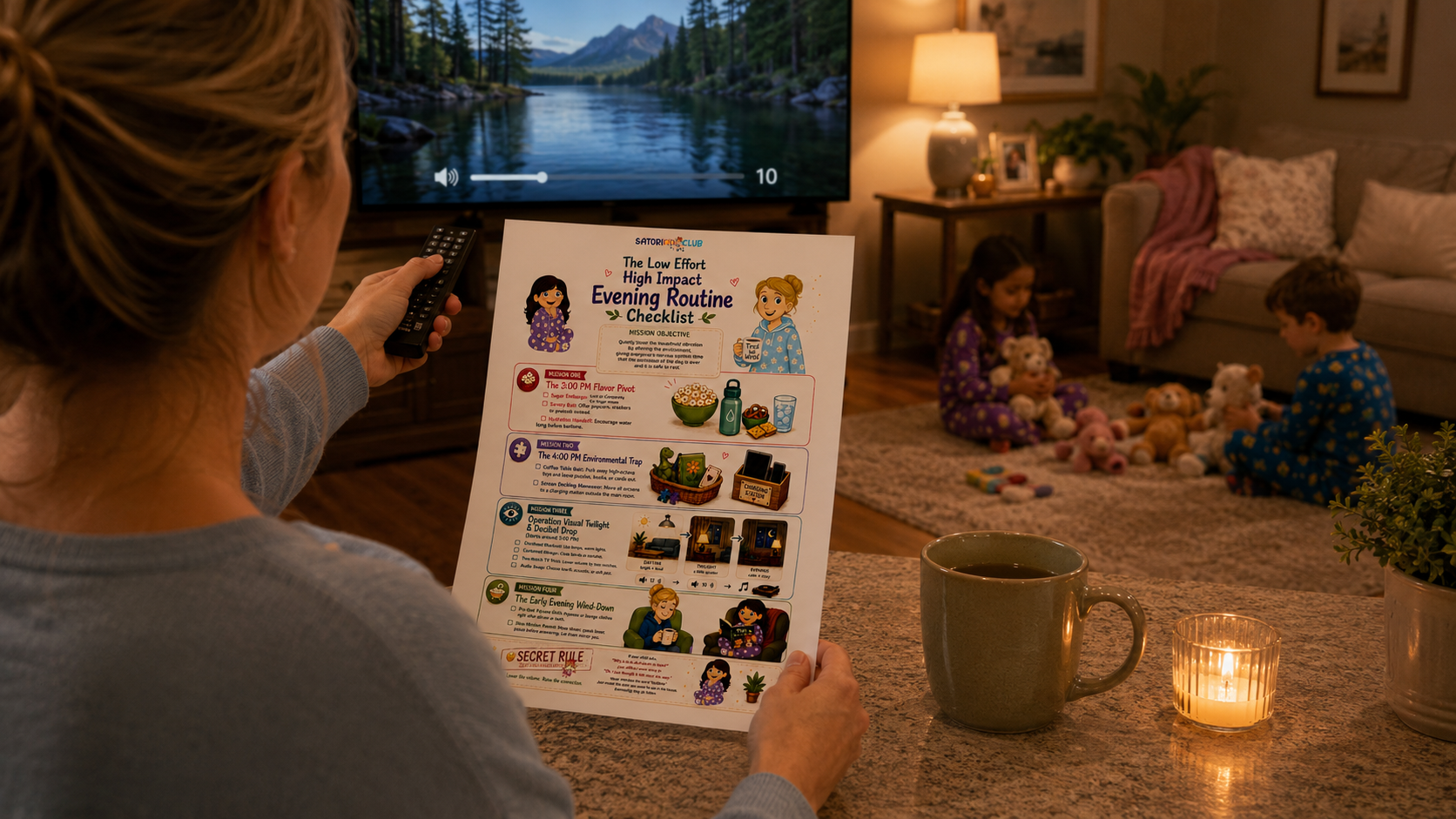
- TASTE (The 3:00 PM sweet spot): I cut out sweet treats after 3:00 PM. (My daughter was very reactive to sugar!) If they wanted an evening snack, we opted for something savory and grounding, like popcorn.
- SIGHT (Lowering the visual stimulation): As evening approached, I moved through the home slowly, turning off bright overhead lights and switching to warm, dim lamps to create an artificial twilight.
- SOUND (Lowering the audio input): I dropped the volume on the TV or radio by a few notches. Because I thrive with background media on, I swapped high-energy, fast-cutting noise for cozy, low-stimulation shows set to a gentle level 4 or 5, or I switched to soft, ambient music.
- The Energy Swap: I began to turn it into a game to see what small environmental things I could swap out to create a low-stim sanctuary before they noticed. They never did.
Gentle Tickles, Closeness, and the 24-Year-Old Proof
The best part of this shift? I noticed something even better than them making it to bed on time: I felt more okay if they didn’t. Because by starting early, my own nervous system had finally been given the time and space to settle down, too.
And because my own nervous system was quiet, I could finally see what my kids actually needed.
For example, my daughter: All day long, she was fiercely independent—running, swimming, exploring, and being her own person in a big, loud world. But when the sun went down, that independence took a lot of energy to maintain. At bedtime, she didn’t need a lecture on sleep guidelines. I tried that. It DID NOT work. She needed closeness. She needed to be rocked, or to have her back tickled while we softly talked about nothing and everything.
Here is the honest reality: I could never have done that connection time justice with a wired system of my own. If I was still revved up from the chaos of the day, her asking for a back tickle felt like one more demand on my exhausted body. But when I started lowering the energy of the house early, I actually had the presence to just sit with her.
This is the deeper principle behind the bedtime battle: Self-awareness begins with learning to process our feelings together. Bedtime wasn't a tactical problem to solve with a stricter clock; it was a relational moment that required us to co-regulate. She needed to tap into my calm so her little battery could finally shut down.
And guess what? This isn’t just about surviving the summer of toddlerhood or elementary school. My daughter and I were actually talking about this just a few months ago. She is 24 years old now. Do you know what she told me? She still does this. By the early evening in her own home, the lights go low, the music stays soft, and the TV volume drops. She is still using these exact same techniques to manage her overstimulation as an adult.
You aren't just trying to survive tonight. You are modeling a lifelong gift of self-awareness.
Closing Thoughts: Trust the Process
At the end of the day, remember that bedtime isn't a test you need to ace; it’s a transition you get to share. By focusing on your own calm and letting the household energy shift with stealth instead of force, you aren't just getting them to sleep tonight—you are teaching them how to find their way back to peace for the rest of their lives.
💡Bring This Practice into Your Home:
Moving the energy of an entire household takes stealth, not brute force. You cannot yell a house into a state of peaceful calm (ask me how I know).
To help you start swapping out high-stim chaos for low-stim peace, I’ve put together a simple, actionable tool for you.
It’s the low-effort, high-impact Evening Routine Checklist.
It contains those ridiculously simple yet easily forgotten environmental tweaks you can start making this afternoon to quietly lower the collective household vibration—without your tiny lawyer even realizing you're doing it.
How to get it: The checklist is a free resource when you join the Satori Kid Club community—it’s completely free to join. Every week, straight to your inbox, I share one practical, bite-sized tool just like this to help you move past daily power struggles and get back to what really matters: building a stronger relationship with your child.
Coming Next Week in Our Summer Survival Series:
"Should I be allowing my child to use screens in the summer?"
If you have typed some version of this question into Google lately with a heavy dose of parent guilt, next week’s edition is your permission slip to breathe. Most summer advice forces you into an all-or-nothing box: enforce rigid time limits or feel like a failure.
But if you are running on empty and raising a child who needs a safe, predictable space to decompress from a loud world, the standard advice isn't working.
Next week, we are looking at why a screen isn’t a moral failing—it can actually be a powerful tool for sensory regulation when used intentionally. We’ll dive into how processing our own parent anxiety and guilt around technology is the secret to creating a balanced summer rhythm.
Make sure you're subscribed so you don't miss next Tuesday's email!
Frequently Asked Questions
How do I handle summer bedtime when it’s still light outside?
The sun staying up late is a major trigger for the "Tired but Wired" paradox. Your child's brain relies on environmental cues to produce melatonin. If the sun won't cooperate, you have to create an artificial twilight inside. Investing in blackout curtains could help, but more importantly, begin the "sensory dim" (lowering overhead lights and switching to warm lit lamps) a few hours before actual sleep time can go along way to signaling their nervous system that the day is ending.
What should I do if my child resists a quieter evening routine?
Don't announce the change. Announcing a new "bedtime wind-down" invites an immediate power struggle. Instead, take a stealth approach. This is where I invite you to model the behaviour you want to see first without expectation. Quietly turn down the TV volume by two notches, swap high-energy toys for a puzzle on the coffee table, and shift the snacks from sweet to savory. Change the environment, and their energy will naturally follow the cue.
Is it okay to let kids stay up later during the summer?
Flexibility is part of the magic of summer, but consistency keeps the nervous system feeling safe. It is perfectly fine to have a later summer bedtime, provided the routine and the wind-down space remain consistent. The goal isn't a rigid clock; it's avoiding an overstimulated nervous system that crashes into an emotional breakdown at the end of the night.
How does parental burnout affect a child’s bedtime?
Our own energy naturally impacts our children. If you are approaching bedtime feeling "touched out," stressed, and rushed, your child's nervous system will mirror that high-alert energy, resulting in bedtime stalling and defiance. Prioritizing your own sensory cool-down in the afternoon is one of the most effective ways to help your child feel settled enough to sleep.
☀️Read More from My Summer Survival Series



Angela Thibault is the creator of Satori Kid Club and the author and illustrator of children’s stories that children’s stories that help children learn to process BIG feelings with confidence. She is a Relational Growth Specialist who guides families in practicing emotional awareness together through dual growth between the grown up and the child. A mother for twenty-eight years, Angela has spent the last fourteen years dedicated to early childhood emotional development and relationship-based learning.
Available Now!

Also Available in
Canada Online At:
(Availability May Vary)

and in the U.S. Online At:
(Availability May Vary)




Additional Posts You Might Like!