

Start your journey here
How to Discipline a 5-Year-Old Who Won’t Listen: Have You Tried Listening to Them First?
All activities should be supervised by an adult.
Share


If you are wondering how to discipline a 5-year-old child who just won't listen, the most effective approach is to shift from forcing obedience to creating a Discipline of Understanding. By downloading our free, printable Satori Shift™ Parent Reminder Guide for your fridge, you will learn a gentle 5-step process designed to help you Notice physical tension, Connect with yourself, Listen to what feelings are trying to tell you, Validate the struggle, and Choose a centered response rather than reacting blindly.
In this Article:
Learning to create an emotional growth practice.
- Shift the Goal: Move away from forcing strict compliance and step into a daily practice of understanding.
- The Steady Anchor: Use The Satori Shift™—our gentle 5-step process—to find your own grounding before meeting your child's big feelings.
- Look Beneath the Surface: Discover how peeling back daily behaviors like defiance or avoidance reveals the tender internal world our children are navigating.
As a parent, I believe the fastest way to get a child to listen may be to spend more time listening to them.
I can also tell you it can be more than frustrating when your child seems to intentionally have you repeating yourself like a parrot on Groundhog Day. I mean, exactly how many times does one have to say "get your shoes on" before it sinks in? Don’t they understand we have things to do?
But that’s the thing. They don’t. They are five.
When answering the question, "How do I discipline my 5-year-old child?" I believe we should consider reframing our approach. Instead of asking how we can force compliance, we should be asking: How can we create a Discipline of Understanding within ourselves? How do we build an Emotional Growth Practice that allows us to create an environment where our child feels safe to process their feelings, opening the door to communication rather than just demanding obedience?
Why Traditional Discipline Fails a 5-Year-Old Who Won't Listen?
I know the "special" torture of the 4-to-7 age range. They look older, they can do more, yet they are definitely testing their independence. It makes a parent want to pull their hair out. We want them to be autonomous, but we also just need to leave the house. So why won’t they just do what we say? Can’t they see we have the experience and know better?
The truth is, they aren't trying to be difficult; they are simply young. They aren't living in our adult world of deadlines and efficiency; they are living in their own, emerging reality.
For years, I tried the "conventional" route—putting my foot down, demanding obedience, and enforcing control. It never worked. It only ever added tension, resentment, and distance between me and my children. It was like I was fighting a war I was destined to lose, and it felt like I was losing them in the process.
The shift happened when I stopped listening to the "experts" and started listening to my own gut. I realized they didn't need to be forced; they needed to be understood. When I started practicing a different way, it was like living a different life. Things smoothed out, and our relationship grew stronger.
How Does Changing My Communication Help My Child Listen?
The surprising thing was that my children did not suddenly become perfect listeners. What changed was me. When I learned to understand my children's internal world, my communication with them changed. I stopped seeing behavior as the whole story and started becoming curious about what might be underneath it. And when my communication style changed, their willingness to listen changed too.
That does not mean I stopped having boundaries or expectations. It means I stopped assuming I already knew why a behavior was happening.
To help make sense of this shift, look at how reframing our perspective changes how we handle daily frustrations:
| When Behavior Looks Like... | Traditional Control Assumes... | The Discipline of Understanding Asks... |
|---|---|---|
| Defiance | They are intentionally disobeying me. | Is unexpressed frustration or overwhelm underneath this? |
| Avoidance | They are being lazy or uncooperative. | Is there a hidden fear or anxiety making them pull away? |
| Not Listening | They are disrespecting my authority. | Is my child struggling with an internal landscape I can't see? Does my child have trouble with transitions? |

This is the Discipline of Understanding. It does not mean removing boundaries. It means becoming curious before deciding what to do next. It is a daily parental practice of taking the steps to slow down and understand. It is a way of life, part of the Parallel Journey™ I am walking alongside my children.
Understanding did not solve every problem, but it helped me identify the real problem, and that changed everything.
How Can Little Stories for Big Feelings Help My Child? Meet Myla and Aditha.
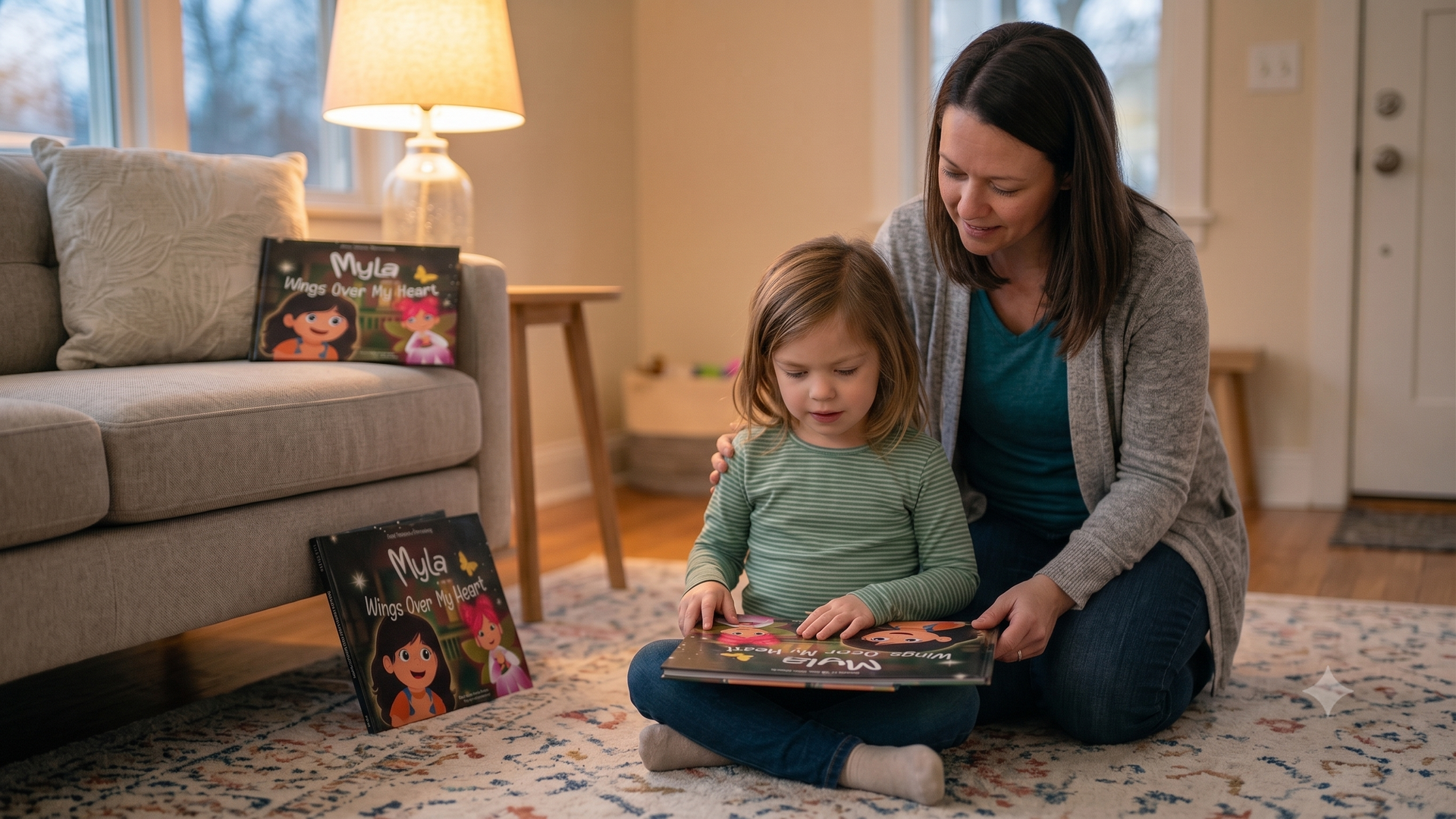
This is exactly why I created Myla, a 6 year old girl with big feelings. In Myla Learns Wings Over My Heart, the first in my series, Little Stories for BIG Feelings, I have built a world children grow with. Myla represents our children. She navigates vast internal landscapes of fear, confusion, and discovery that exist separate from our adult lives.
When Myla hides in the garden, it looks like avoidance. If we only looked at her behavior, we might assume she is refusing to go to school. But just like many of our own children, there is more to the story. Her tummy ache is actually fear trying to get her attention. What first looked like avoidance turns out to be overwhelm from her internal and external world.
In the story, Aditha comforts and anchors Myla in the exact same way we, as parents, are called to comfort our own children when their emotional storms hit. Aditha doesn't rush to fix Myla's feelings or force her out of the garden; instead, she models the steady, patient presence our children look to us for. With Aditha gently guiding her to listen to her body, Myla learns how to navigate her big feelings through connection rather than control.
What Techniques Can Help You Stay Calm as a Parent?
Let's Try the 5 Steps of the Satori Shift™.
I don't have all the answers. What I do have is 27 years of parenting, plenty of mistakes, and a lot of opportunities to learn what helped my family and what didn't.
Over time, I realized that if I didn't have a way to steady myself, I didn't stand much chance of helping my children steady themselves. The Satori Shift™ grew out of that realization. It is not about fixing my children; it is about shifting my perception from controlling the situation to understanding them so I am steady enough to show up for them.
When I feel the spiral starting, I lean into this 5-step practice:
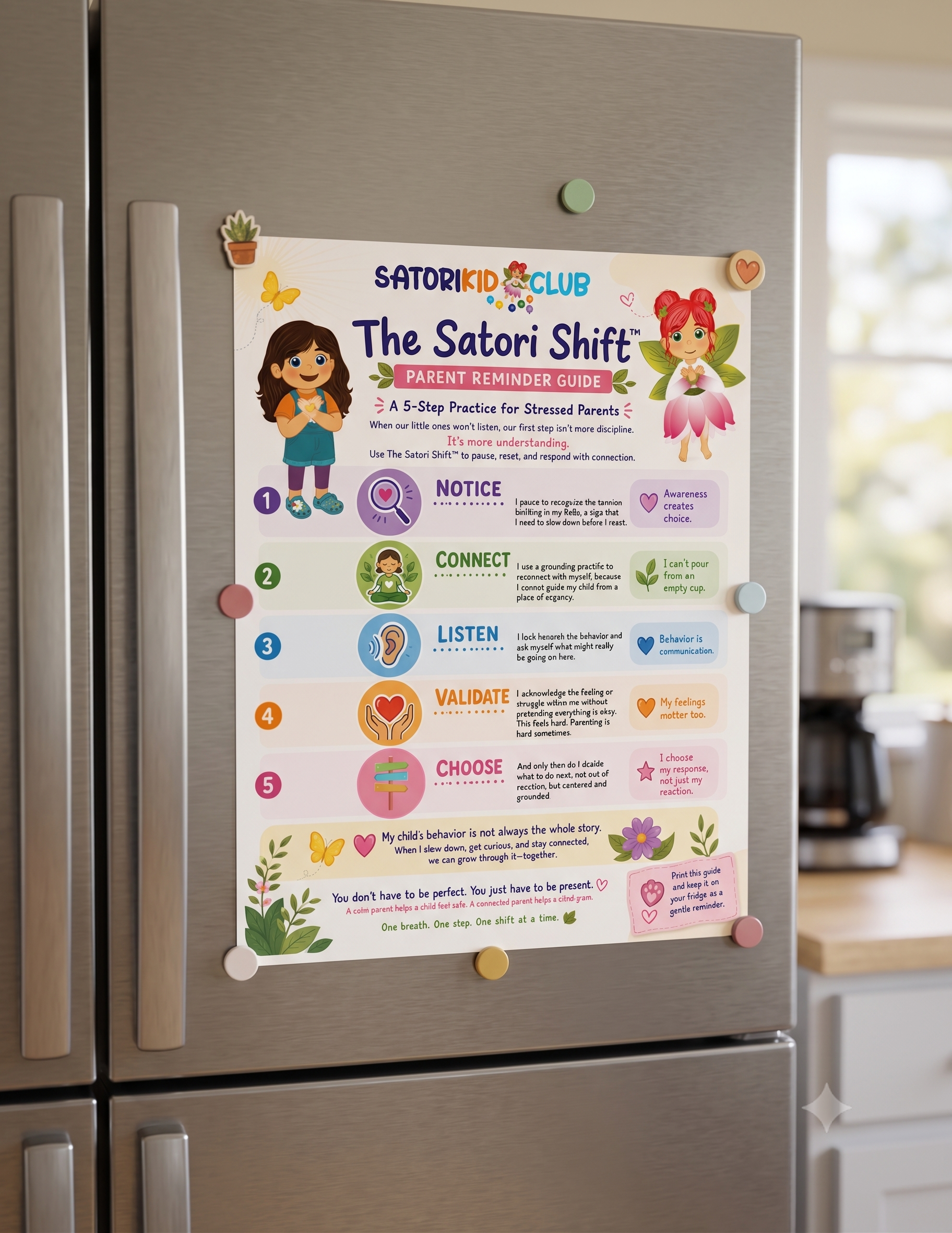
Notice: I pause to recognize the tension building in my body, a sign that I need to slow down before I react.
Connect: I use a grounding practice to reconnect with myself, because I cannot guide my child from a place of urgency.
Listen: I look beneath the behavior and ask myself what might really be going on here.
Validate: I acknowledge the feeling or struggle within me without pretending everything is okay. It’s okay, this feels hard. Parenting is work.
Choose: And only then do I decide what to do next, not out of reaction, but centered and grounded.
💡
Bring This Practice to Your Home: You don't have to memorize these steps in the heat of a melt-down. I put this exact 5-step framework into a beautiful, visual
Satori Shift™ Parent Reminder Guide that you can print out and keep on your fridge as a gentle daily anchor.
Conclusion: Moving from Control to Connection
Discipline doesn't have to be a battle of wills. By shifting our perspective from forcing obedience to fostering understanding, we can transform daily frustrations into opportunities for emotional growth.
Remember, the goal isn't to create a perfect listener; it’s to build a resilient, communicative relationship where your child feels safe processing their big feelings. While the path from control to connection takes practice, you don't have to navigate it alone.
By applying the Satori Shift™—noticing your own tension, connecting with your needs, listening to what lies beneath the behavior, validating your child’s struggle, and choosing a grounded response—you create the steady foundation your child needs to flourish.
An emotional growth practice is not about adding more to your plate; it is about creating the space to actually handle what is already on it. It takes time and practice, but it is how we grow together.
Here’s to building a world our children can grow with—and a space where we can grow right along beside them.
Questions often asked by caring grownups on this journey too.
How do I help my child learn where feelings are showing up in their body?
Download PrintableA simple way to help your child learn where feelings are showing up in their body is through a short, story‑led body scan. If you want a gentle script you can use tonight, you can download our free "Stop and Notice Body Scan Activity With Myla and Aditha."
☀️Read More from My Summer Survival Series



Angela Thibault is the creator of Satori Kid Club and the author and illustrator of children’s stories that children’s stories that help children learn to process BIG feelings with confidence. She is a Relational Growth Specialist who guides families in practicing emotional awareness together through dual growth between the grown up and the child. A mother for twenty-eight years, Angela has spent the last fourteen years dedicated to early childhood emotional development and relationship-based learning.
Available Now!

Also Available in
Canada Online At:
(Availability May Vary)

and in the U.S. Online At:
(Availability May Vary)




Additional Posts You Might Like!