
Start your journey here
How to Create a Safe Space to Explore Feelings this Summer: Your Emotional Growth Awaits You
All activities should be supervised by an adult.
Share
Inside this article: Whether you're creating a calm down corner for the first time or upgrading the one you already have, this guide will show you how to transform it into a proactive Growth Garden without spending a small fortune. You'll discover the five essential tools I recommend every family start with this summer, how to use them together on centered days, and how to build a simple emotional awareness practice that grows stronger relationships one tool at a time.
In this article, you'll learn:
- How to create a Growth Garden from scratch or upgrade the calm down corner you already have.
- The five essential Growth Garden tools every family should start with this summer.
- How to use each tool proactively before BIG feelings show up.
- Why practicing together helps children and grown-ups build emotional awareness side by side.
- How to turn your calm down corner into a proactive space without spending a small fortune.
- How to download your free Growth Garden Starter Kit and continue adding one new tool each week by joining the club.
🎁 Bonus 5-Free Tools Included:
This free downloadable
kit gets you started setting your Growth Garden this week!
Setting Yourself Up for Success
Proactively Creating a Space to Process Emotions This Summer
Summer can be beautiful.
It can also be a lot.
The routines change. The days feel longer. Everyone is together more often. And even the sweetest summer moments can quickly turn into sibling fights, boredom spirals, transition struggles, and BIG feelings that seem to come out of nowhere.
So if you already have a calm down corner that is not working the way you hoped, or you have been wondering if you should create one, I want you to know this:
It's not you.
It's not even space.
It's the intent of HOW the space is used.
You may simply need to bring a few new tools into the space you already have. And no, you don't have to go on a new shopping spree. Unless that is something you are looking forward to.
If you read last week's article "Creating Space to Process Emotions This Summer", you already know why I encourage families to shift from using a calm down corner as a reactive space to using it as a proactive space for learning and growth. If you missed it, I recommend reading that article first before continuing.
Today, I want to show you what that actually looks like.
Whether you already have a calm down corner that could use a simple upgrade or you're starting from scratch this summer, creating a Growth Garden doesn't have to be complicated or expensive.
In fact, you may already have everything you need to get started.
CREATING A SAFE SPACE TO EXPLORE FEELINGS
Like in my story Myla Learns Wings Over My Heart, Myla's safe space to explore her feelings is the garden. In that same spirit, the Growth Garden becomes your family's space to explore, understand, and learn to process BIG feelings together.
When we learn to process our feelings, we grow self-awareness. Self-awareness leads to better communication, and better communication builds stronger relationships.
Relationships are not a destination we get to; they are a journey we take side by side.
The Parallel Journey™ with the 5-step Satori Shift™ process of Notice > Connect > Listen > Validate > Choose is meant to help grown-ups walk that journey alongside their child.
The best part is that you don't need to build the perfect space before you begin. You simply need a place where you can practice together.
Let's get you building stronger relationships by setting up your Growth Garden this summer.
Why a Proactive Space Matters This Summer
Moving from a reactive "calm down corner" to a proactive Growth Garden changes everything. When we wait for a meltdown to teach emotional regulation, we are asking an overwhelmed brain to learn a brand-new skill. By practicing on calm, centered days instead, we give our kids an emotional roadmap before the storm hits.
This summer, your calm down corner can become a collaborative, playful space that transforms daily friction into a deeper connection—long before those BIG feelings arrive.
3 Common Mistakes to Avoid with Calm Down Corners
Before we look at the tools, let's clear away the pressure. A Growth Garden works best when we avoid a few common pitfalls:
- Using it as a timeout zone: If a child is only sent there when they are in trouble, the space feels like a punishment, not a sanctuary.
- Expecting kids to use it alone: True emotional awareness is caught, not just taught. It relies on The Parallel Journey™—us practicing right alongside them.
- Overcomplicating the setup: You don't need a massive budget or a perfect sensory room
In fact, your Growth Garden Checklist requires only three simple things:
- a quiet physical spot
- your printed tools
- a shared commitment to practice together on centered days
Your Growth Garden Needs the Right Tools
One of the biggest misconceptions about creating a calm down corner or Growth Garden is that you need to spend hundreds of dollars filling it with sensory toys and expensive furniture.
The truth is you probably already have most of what you need. I'll keep saying it. It's less about where the space is than having consistent practice.
This summer, I want to help you focus less on buying more things and more on building a collection of activities that act as tools that help you and your child practice emotional awareness together.
Think of it just like a real garden.
A gardener doesn't expect one tool to do every job. They slowly build a tool shed over time, adding the right tool for the right season.
Your Growth Garden Tool Shed works the same way.
Each printable, activity, story, and regulation strategy becomes another tool you can reach for as your family grows together. You don't need every tool on day one. You only need enough to get started.
These are the five tools I recommend every family begin with this summer.
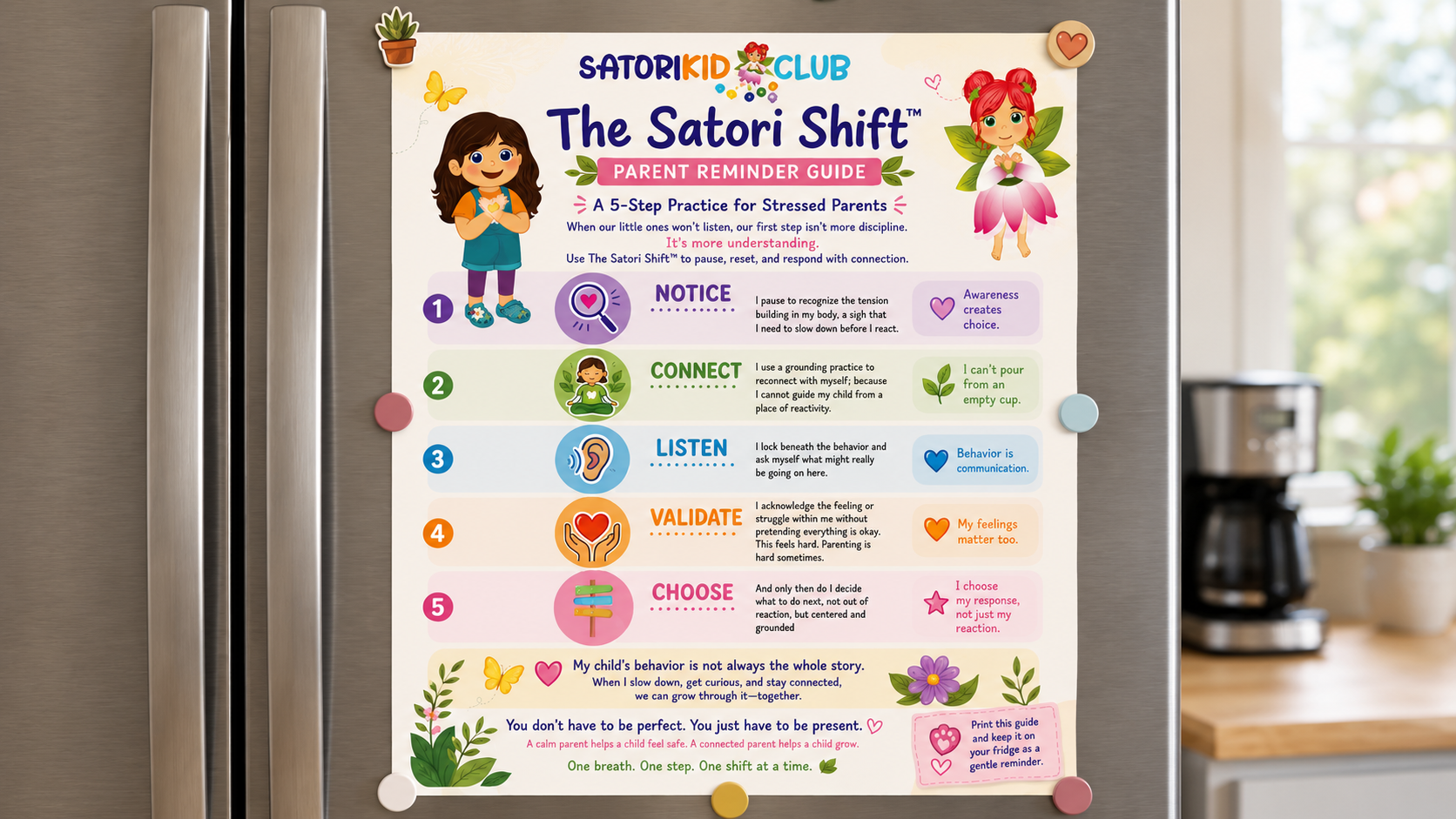
Tool 1. The Satori Shift™ Fridge Reminder
The first tool I recommend adding to your Growth Garden is the Satori Shift™ Fridge Reminder.
It might not look like much, but don't underestimate its importance.
When BIG feelings show up, it can be difficult for both children and grown-ups to remember what to do next.
Having a simple visual reminder somewhere you see every day helps turn emotional processing from something you only think about during hard moments into something your family practices consistently over time.
Don't wait for BIG feelings to introduce these concepts. Spend a few minutes practicing it together on calm, centered days. The more familiar the process becomes before a storm, the easier it is to return to when emotions feel overwhelming.
I recommend placing your Satori Shift™ Fridge Reminder somewhere central in your home. The refrigerator door is a great option because everyone naturally walks by it throughout the day. In a classroom, you might choose a wall near your Growth Garden or another area where you regularly gather together.
Remember, this isn't meant to become another poster your family stops noticing after a week.
Use it.
Point to it.
Talk about it.
Celebrate it.
When your child comes to you with a disappointment, point to the first step and ask, "Let's Notice. You look a little disappointed at the moment."
If you're feeling overwhelmed yourself, model the process out loud.
"I'm noticing my shoulders are really tight."
"I think I need to Connect before I decide what to do next. I am going to try Butterfly Taps today"
One of the greatest gifts we can give our children is letting them see us practicing too.
That's The Parallel Journey™ in action.
Over time, these five simple words—Notice, Connect, Listen, Validate, Choose—begin to feel familiar. Instead of trying to remember the process in the middle of a stressful moment, your family begins developing a shared language around emotions.
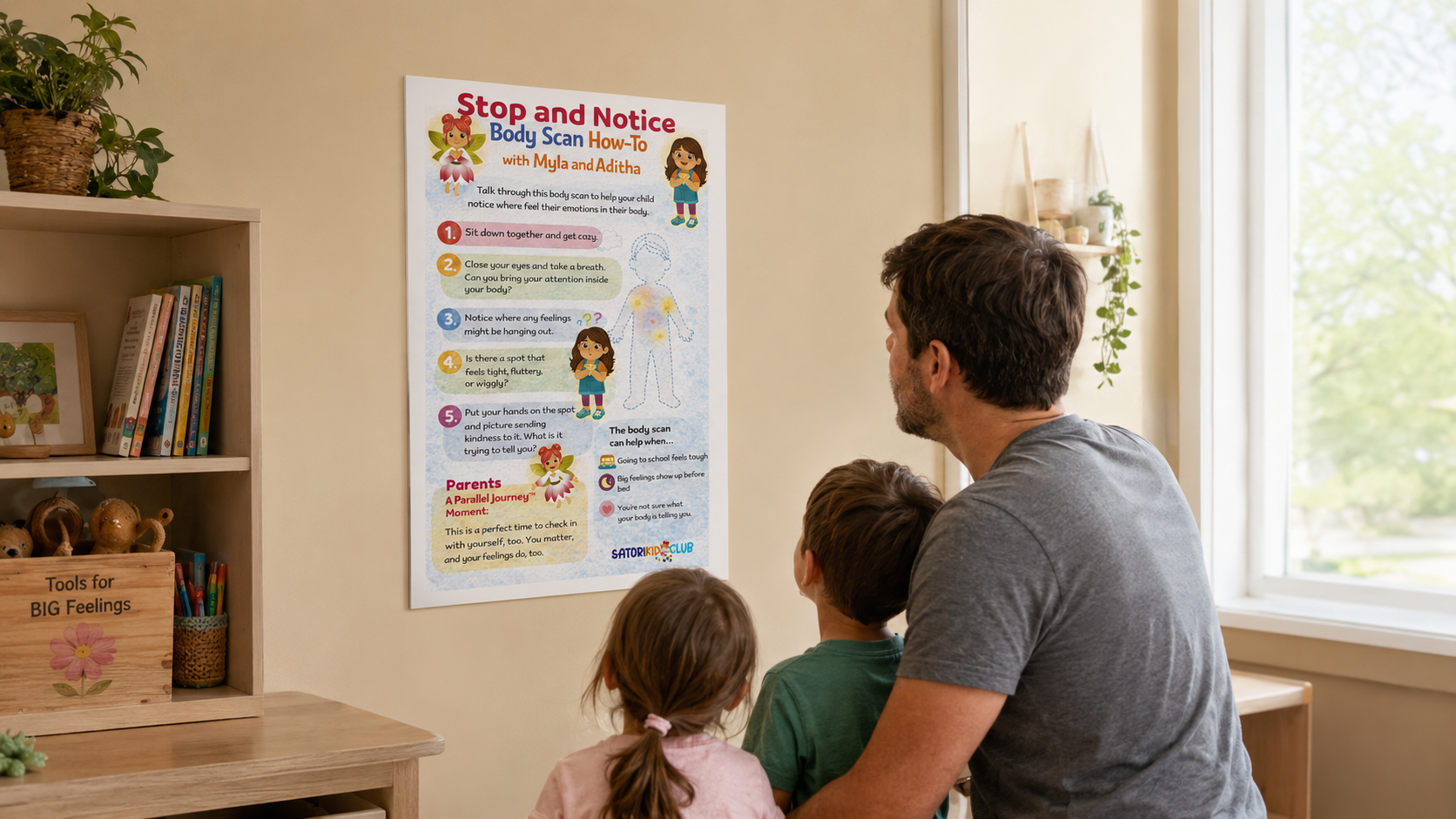
Tool 2. Stop & Notice Body Scan Chart
Now that you have a visual reminder of the five steps, it's time to begin with the very first one: Notice.
The Stop & Notice Body Scan Chart helps children and grown-ups slow down long enough to recognize what their body is trying to communicate before jumping straight into solving the problem.
Many children don't yet have the words to explain how they feel.
Instead, they might tell you their tummy hurts, stomp away, slam a door, or simply say, "I don't know."
Our bodies often notice our feelings before our minds can make sense of them.
That's why this chart is such an important tool in your Growth Garden.
Place the Body Scan Chart where both you and your child can easily see it during your time together.
When you're practicing on calm, centered days, invite your child to become curious about what they notice in their body.
You might ask:
- "Put your hand on your heart. Is it tapping fast like a rabbit, or slow like a turtle?"
- "Are there lots of busy thoughts bouncing around in your brain right now?"
- "Does your tummy feel quiet and still, or is it wiggly like butterflies are inside?"
There are no right or wrong answers.
The goal isn't to identify the "correct" feeling.
The goal is simply to notice.
As your child becomes more comfortable recognizing their body's signals, you'll begin creating an important foundation for emotional awareness.
Over time, they may start noticing these same body cues during moments of frustration, disappointment, worry, or excitement, making it easier to move through the rest of the Satori Shift™ together.
Remember, you're practicing too.
As a grown-up, use the Body Scan Chart for yourself.
Saying something as simple as,
"My shoulders feel really tight today."
or
"I'm noticing my tummy feels a little nervous." shows your child that learning to notice our feelings is something we continue practicing throughout our lives.
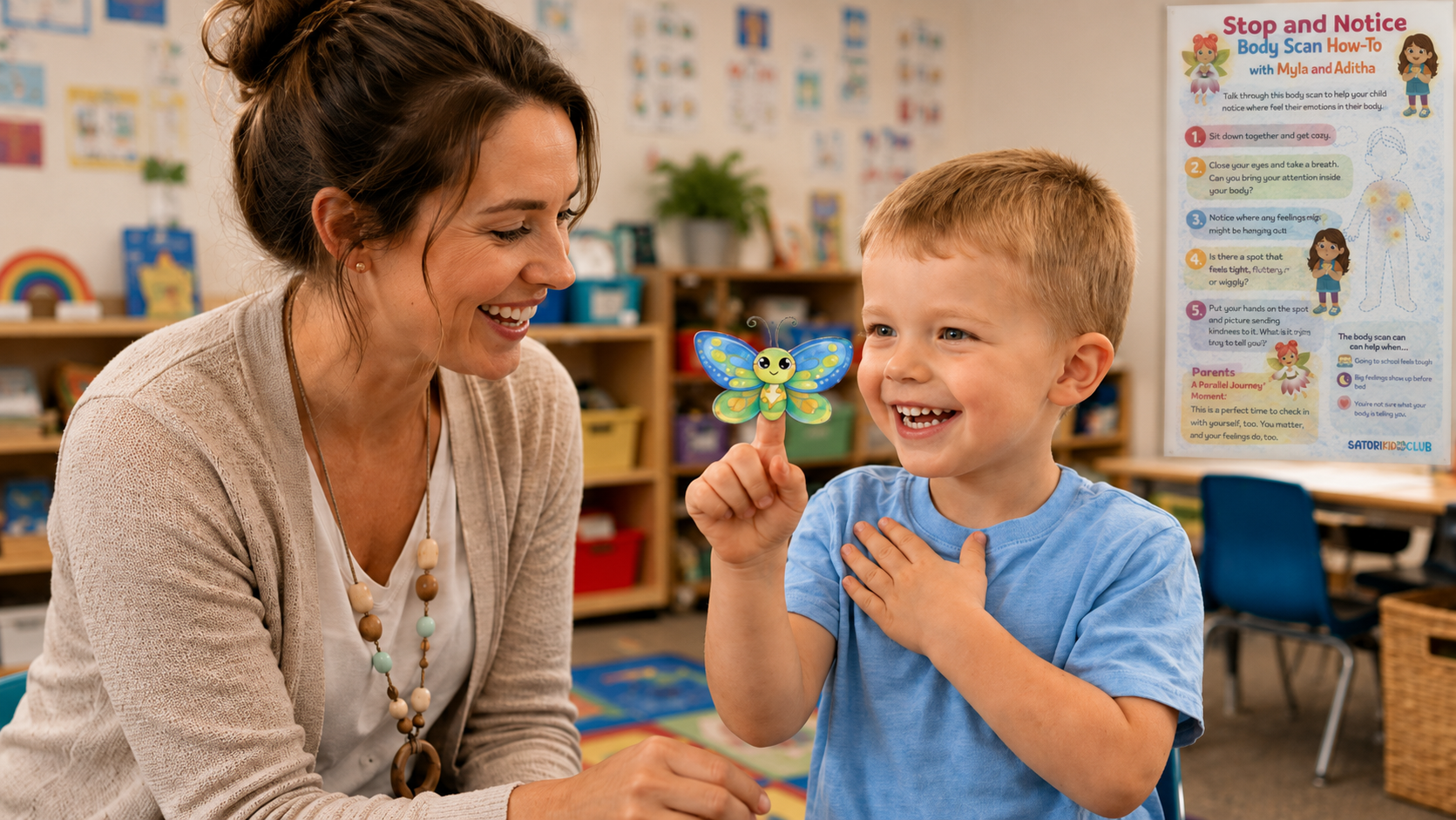
Tool 3. Your First Connect Tool: Butterfly Taps
Now that you have practiced the first step of the Satori Shift™ — Notice — it's time to move to the second step: Connect.
Connect is not about forcing your child to calm down on demand.
Connect is about helping both of you become centered enough to get curious about what your feelings are trying to tell you.
One of my favourite ways to practice Connect is with Butterfly Taps.
If you've read Myla Learns Wings Over My Heart, you'll recognize this simple body-based tool. Butterfly Taps are the same practice Myla learns in the story to help her connect with herself when BIG feelings begin to appear.
That's why the Butterfly Finger Puppet is included as one of the first tools in your Growth Garden Tool Shed.
Young children are still developing the coordination needed to perform Butterfly Taps on their own. The finger puppet gives them a simple visual guide to follow so they can learn the rhythm of the taps without worrying about whether they are doing it "right."
It turns the practice into play.
On a centered day, read Myla Learns Wings Over My Heart together. Then use the Butterfly Finger Puppet to practice Butterfly Taps side by side.
Let your child follow the butterfly.
You follow it too.
Notice what happens in your bodies before, during, and after the practice.
The goal is not for your child to master Butterfly Taps perfectly.
The goal is for both of you to learn what it feels like to Connect.
Over time, this tool becomes familiar. Your child begins to remember the butterfly, the rhythm, the story, and the feeling of practicing with you.
That is what makes it easier to return to when BIG feelings arrive.
You are not handing your child a tool and expecting them to use it alone.
You are practicing the tool together so both of you know how to find your way back to center.

Tool 4. Choose My Path™ Connection Plan
One of the biggest mistakes we make during BIG feelings is asking children to make decisions when their brains are already overwhelmed.
Questions like...
"What do you want to do?"
"Which strategy would you like to try?"
or
"How can I help?"
are wonderful questions when a child is feeling centered. During emotional overwhelm, however, too many choices can actually make it harder for children to decide what they need.
That's why I created the Choose My Path™ Connection Plan.
This tool is not meant to be filled out in the middle of a meltdown.
It is meant to be explored on centered days.
Start by trying the different
connection tools together when everyone is feeling calm enough to be curious. Try Butterfly Taps. Try Tree Roots Stretch. Try Balloon Belly Breaths. Try Bumblebee Hums.
Make it light.
Make it playful.
Notice what your child naturally enjoys.
And notice what you naturally enjoy too.
Some children love movement. Some children love pressure. Some children like sound. Some children need quiet.
Some grown-ups do too.
This is why we try the options first instead of assuming we already know what will help.
After you have practiced all the tools together, invite your child to choose two of their favourites for their Connection Plan. You choose your two favourites as well.
This gives both of you a simple path to return to when BIG feelings show up.
Instead of trying to sort through every possible strategy during an overwhelming moment, you both already have a plan you created together.
That matters.
When children help choose the tools that feel supportive to them, they begin developing autonomy. They are learning, "I have options. I can notice what helps me. I can be part of caring for myself."
When grown-ups choose their tools too, children see that emotional processing is not something children are expected to do alone. It is something we practice together.
Your child may choose Butterfly Taps and Tree Roots Stretch.
You may choose Dance it Out and Bumble Bee Hums.
Then you both have a plan.
That is practice.
That is modelling.
That is The Parallel Journey™ in action.
I also recommend keeping the extra options together in a binder, folder, or large zip-top bag near your Growth Garden. Your child's favourites may change as they grow, and that's okay. Your favourites may change too.
The technique can change because you are both learning what supports you.
The goal is not to lock anyone into one perfect strategy.
The goal is to help both of you learn how to choose what supports you.
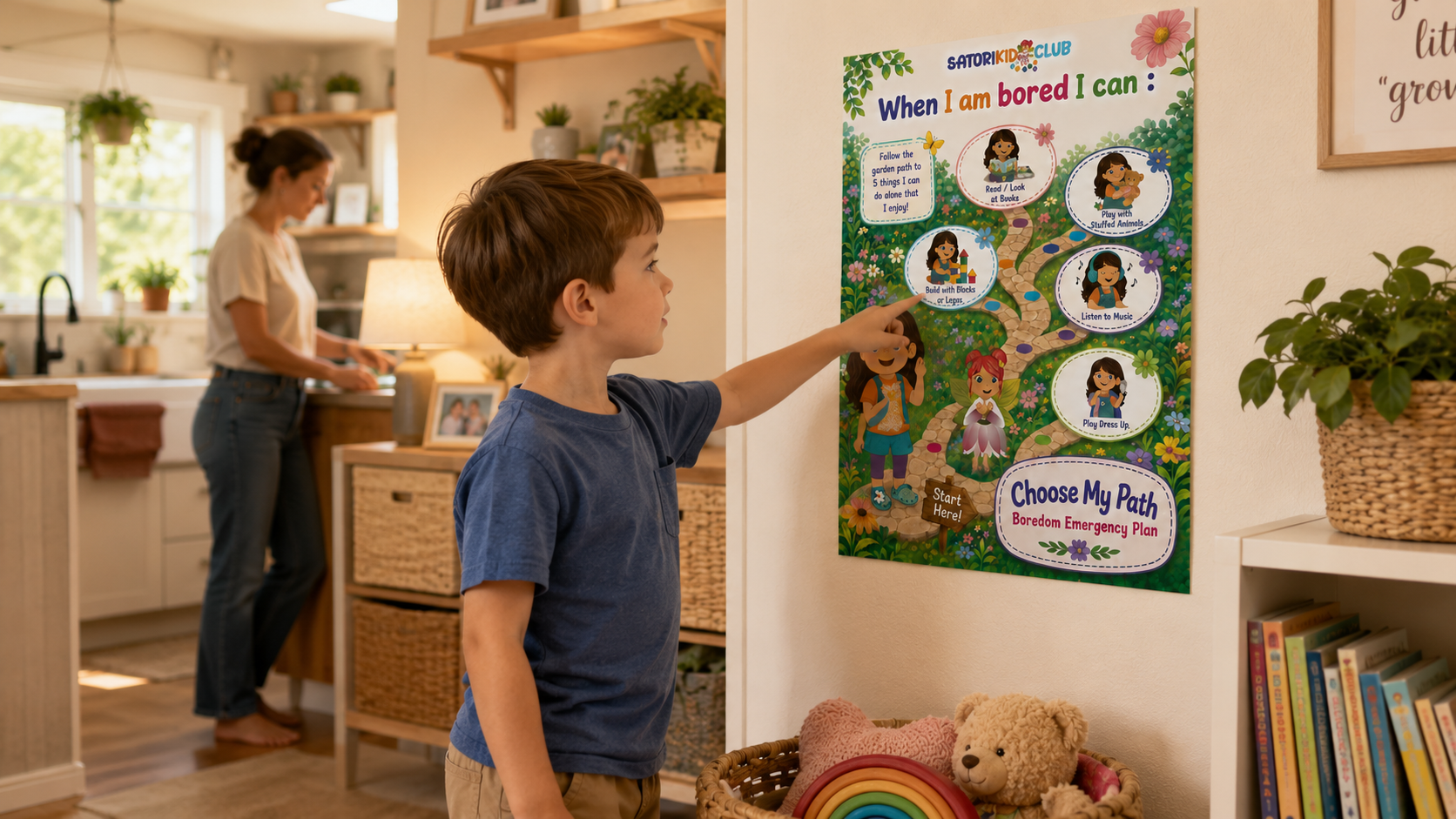
Tool 5. Choose My Path™ Boredom Emergency Plan
If you ask most parents what triggers the most frustration during summer break, boredom is usually near the top of the list.
"I'm bored."
"I don't know what to do."
"There's nothing to do."
Those words often arrive long before the BIG feelings do.
That's why I created the Choose My Path™ Boredom Emergency Plan.
Instead of waiting until frustration builds into arguing, whining, or emotional overwhelm, you and your child create a simple plan together before boredom becomes an emergency.
Just like your Connection Plan, this activity is meant to be completed on centered days.
Sit down together and explore the different activity choices. Talk about which ideas sound fun, which activities help your child feel connected, and which ones your family enjoys doing together.
Then create your Boredom Emergency Plan together.
When the inevitable "I'm bored!" arrives, you don't have to scramble for ideas or carry the responsibility of entertaining everyone.
Instead, you can simply say,
"Let's go to our Boredom Emergency Plan."
Your child already helped create it.
They already know the choices.
Now they get to choose their path.
That small shift builds something much bigger than independence.
It builds confidence.
It teaches children that boredom isn't something to fear or something another person has to fix for them. It's an opportunity to become curious, make a choice, and discover what they enjoy.
And just like every other tool in your Growth Garden, grown-ups participate too.
Choose a few activities that help you reconnect with yourself when you have a few quiet moments.
Maybe it's reading a book.
Maybe it's working in your garden.
Maybe it's enjoying a cup of coffee outside while your child explores one of their chosen activities.
The Parallel Journey™ reminds us that emotional awareness isn't only for children.
Summer is an opportunity for all of us to practice noticing what fills our own cups too.
Key Takeaway
You do not need to create a perfect calm down corner for it to become helpful.
You need a space where you and your child can practice the tools before BIG feelings arrive.
By adding a few intentional Growth Garden tools, your calm down corner can become more than a place your child goes when they are overwhelmed. It can become a proactive space where you practice noticing body signals, connecting with yourselves, choosing supportive tools, and building emotional awareness together.
That is how the space begins to shift.
Not because you bought more things.
Because you changed what the space is for.
💡Bring This Practice into Your Home:
If you're anything like me, you don't need another parenting article that leaves you feeling inspired but wondering what to do next.
You need a place to start.
That's exactly why I created the Growth Garden Starter Kit.
Inside, you'll find all five of the tools we explored in this article bundled together, so you can begin creating or upgrading your own Growth Garden this summer.
To get your kit, simply join the Club — it’s free.
Every week, I'll send a brand-new Growth Garden tool straight to your inbox, giving you another activity to add to your family's Tool Shed. Some weeks it might be a printable, another week it could be a new activity, a reflection tool, or a seasonal resource to help you continue growing emotional awareness together.
Think of it as slowly building your Tool Shed, one tool at a time.
You don't have to figure it all out this summer.
You don't have to have every answer.
You just have to keep showing up, practicing together, and continue growing with love.
What’s Next?
Now that you know
WHY we need to shift from reactive corners to proactive spaces, you might be wondering what this actually looks like in your living room or classroom.
Next week, I’ll walk you through exactly HOW to set up your Growth Garden for maximum success. We will talk about choosing the right location, stocking your somatic tools, and introducing the space to your kids without the power struggles.
Don't miss the setup guide! Drop your email below to subscribe to the Satori Kid Club community and get the exact "how-to" blueprint delivered straight to your inbox the moment it drops next week.
Frequently Asked Questions About the Growth Garden
Why do children seem to experience more frequent meltdowns and "BIG feelings" during the summer?
Summer break is beautiful, but the reality is it can also be a lot for young minds. The loss of school-year routines, longer days, and the transition of everyone being together more often can easily trigger boredom spirals, sibling fights, and transition struggles. Because these emotional storms seem to come out of nowhere, having a proactive space set up ahead of time gives your family a clear roadmap to navigate the unique friction of summer break.
What is the difference between a traditional calm down corner and a proactive Growth Garden?
A traditional calm down corner is typically used reactively—a place a child is sent to isolate or cool off after an emotional blowout has already started. A Growth Garden shifts the focus entirely from reactive to proactive. It is a shared, low-cost space where you and your child gather on calm, centered days to practice tools together side-by-side, building emotional awareness before those intense moments arrive.
How can parents teach emotional regulation at home without it feeling clinical or forced?
True emotional regulation isn't about rigid instruction; it’s about connection and play. By walking The Parallel Journey™ using the 5-step Satori Shift™ (Notice > Connect > Listen > Validate > Choose), you take the clinical pressure off. Instead of handing your child a tool and expecting them to use it alone, you explore tools like Butterfly Taps or Body Scan Charts together playfully on your good days. When your child sees you modeling the practices for your own feelings, emotional awareness naturally becomes a comfortable, shared family language.
☀️Read More from My Summer Survival Series



Angela Thibault is the creator of Satori Kid Club and the author and illustrator of children’s stories that children’s stories that help children learn to process BIG feelings with confidence. She is a Relational Growth Specialist who guides families in practicing emotional awareness together through dual growth between the grown up and the child. A mother for twenty-eight years, Angela has spent the last fourteen years dedicated to early childhood emotional development and relationship-based learning.
Available Now!

Also Available in
Canada Online At:
(Availability May Vary)

and in the U.S. Online At:
(Availability May Vary)




Additional Posts You Might Like!