
Start your journey here
Should I Allow My Child to Have Video Games This Summer?
All activities should be supervised by an adult.
Share

Inside this article: If you are completely exhausted by summertime screen battles and iPad meltdowns, this post pulls back the curtain on the exact gaming meltdown that forced me to change my entire parenting approach. You’ll discover the perspective shifts that brought about real change in my own home, introduced through The Parallel Journey™, the essential practice of processing our own parental frustration and fear before we react. Learn how to cleanly navigate your child's nervous system crashes on platforms like Roblox or Minecraft using The Satori Shift™ (Notice, Connect, Listen, Validate, Choose), and grab my free Gaming Your Connection soulful conversation starters to finally swap empty control for true relationship.

Today you'll learn how to Game Your Connection with
your child through:
- Taking Ownership of your role in creating a tiny "Tech-Monster" (with zero judgment, because we have all been there). I'll show you I created mine!
- Learning to Prioritize Relationship and connection over control through Self-Regulation using my 5-step Satori Shift™ method for processing feelings.
- Learning to Communicate with your child about their inner world by getting to know their interests such as gaming.
🎁 Free Companion Resource Included:
To help you put this into practice tonight, I’ve created the Gaming Your Connection conversation starters, so you to finally swap empty control for true connection!
The checklist is a free resource when you join the Satori Kid Club community—it’s completely free to join. Every week, straight to your inbox, I share one practical, bite-sized tool just like this to help you move past daily power struggles and get back to what really matters: building a stronger relationship with your child.
How I almost damaged my relationship with my son over gaming.
Restoring healthy digital habits and boundaries in your home
I am long past the summer battle of screen time use, but hearing friends describe the screen battle era they are in themselves has made me reflect on my own battles won, lost, and eventually a little give and take that restored healthy habits and boundaries in our home.
It makes sense this question arises every summer. When there is almost too much time in a day to fill, what do you even do? I mean, how many macaroni frames can you make in a week? So it’s pretty natural to let your child turn to a screen to fill some of that boredom. Whether it's children’s shows or video games, whatever gave me 5 more minutes of peace while I tried to get some work deadlines completed, I welcomed with open arms. When my children were small, I did work from home and summer really did add extra pressure. No longer did I have the two- to three-hour school window to try and get everything else done.
A Tech-Monster is Born
We have always been a home where the TV is on and video games provided a great new world to explore. I believe my son was about 5 when he was gifted his first GameBoy. He loved it. And coming from the Super Nintendo generation, I loved that my son was getting to know the games I grew up on.
It wasn’t until I tried taking the coveted GameBoy away,ironically so we could make it on time to a movie about gaming, and I was met with a meltdown that could out-rival Chernobyl, that I realized: Houston, we have a problem.
I am pretty sure most of my white hairs come from this one meltdown. My friend was visiting and said, “Man, you are lucky you have witnesses. He sounds like he is being murdered.”
I had no idea what to do, except to wonder, “How on earth did we get here?”
Godzilla has nothing on a tech-addicted child who has their screen taken away!

How Did Screen Time Get So Out of Control?
After many overwhelmed tears and quite a bit of reflection, I realized I may have played a part in this meltdown.
I had basically given a shopaholic an unlimited credit card and said, “But don’t get too much…”
We cannot hand a child a device engineered by world-class neuroscientists to trigger massive, non-stop dopamine loops, and then act surprised or get angry at the child for being addicted to it. A child's developing prefrontal cortex stands absolutely zero chance against a billion-dollar tech algorithm.
And that is exactly what I had done. It was a hard pill to swallow, but I had to see that I had let over-use of screens in the home get out of control because it was easier for me. It was easier because I got a moment of “peace.” I could finish laundry, emails, or dinner all without being “bothered.”
Cue the “mom guilt” and shame.
So, I had created a bit of a Tech-Monster. Fabulous. I was finally aware of it. But how on earth was I supposed to fix it? I mean, obviously, I did not know—I had helped create the issue!
Top Advice Failed
Top parent “gurus” at the time suggested setting screen time schedules. Family suggested he "needed friends to play with and more time outdoors." Friends suggested more discipline.
Yeah, I can tell ya… NONE of that worked.
In fact, the MORE I cracked down, the worse everything got. It got bad enough that once, when he was 11, I put the internet modem in my purse and took it with me to work for the day. No internet, no gaming, right? It seemed logical to me.
It was not logical. It was control. And a failed one at that.
It may have stopped the action, but it also put a massive wedge in our relationship. He stopped trusting me. We often think: Are our kids showing us they can be trusted? But do we think much about whether we are showing them that we can be trusted?
And you may even be thinking, I am the parent. I don't need to earn their trust, it's implied. I am here to tell you trust is not implied. It is earned. Even in parenting.
It is a relationship between parent and child, and as in all relationships, there need to be key elements for it to be healthy and grow. Trust is one of them. Communication is another.
I had nothing left. Every well-meant suggestion had failed miserably. And my gut was screaming that we needed to do things differently. This silly little “battle” was damaging our little family way too much. We had hit an impasse, so I tried talking it out.
Communication Opened Up So Much
Opening up to my child about why this issue felt like a problem was a big help. Of course, I had to approach this in an age-appropriate way. He was old enough to know it was causing disruption in the home, making us late for work and school, etc. He was old enough to know that I was worried he did not have friends, that I wanted to know why he would not go outside, and that I was worried about whether he was getting enough exercise.
Do you know what I got back once I brought this up to him through talking calmly?
His friends were online. That was why he was so upset I took the game away. I thought it was just quests and collecting coins. He told me about how he and his friends talk about all kinds of things—problems at school, etc.—and how they give each other encouragement and advice. Just because they are not sitting in the same room doesn’t mean they are not friends.
Then he said, ”It’s like your friend in another province. You talk on the phone, you're not in the same room. Doesn’t mean you are not friends.”
I brought up the fact that I was worried he was not getting enough exercise and he responded well to that, too: “I play basketball at school… I’m not going for the team or anything, but I do.”
So I asked HIM what he felt would be a compromise here. This was not giving in or letting him get his way. It was about understanding that he was getting something profound out of something I did not understand.
We eventually came to an understanding that changed and grew as we did. He would schedule time with his friends online the same way you would schedule a one-on-one playdate. If we had other family plans, he may have to decline from joining his friends. That is typical of many homes. But he did not make that schedule. I was still the parent here. I did.
And I know many people thought it was me giving in. The thing is, I stand by it. To this day, he is still best friends with the friends he made online at 11 years old. He is now 27. They have been there for each other through life’s major changes—jobs, marriages, everything. He has even gone to visit them in other countries. This is not a closed-off, shallow world.
Just because I didn’t understand it at first didn’t
make it less real.
A Few Caveats Though
Did it take monitoring? Hell yes. Online safety first, always. Did the agreement change over time? Yes. How much he was allowed to engage at 10 compared to his later teen years mattered. The types of games he engaged with mattered.
This was not a case of, “Oh, I understand now, you are free to do whatever you want.” Absolutely NOT.
That’s how the Tech-Monster was created in the first place.
It was about taking a moment to learn from my child what he was getting out of it, instead of me assuming I already knew. (Well, we all know what happens when you assume). But then, after validating that, I had to explain why it was important that this could not take over our lives and that we needed to create balance. It was also important for me to embody that and model those boundaries myself. Because it’s not as if the issue never came up again, I have never met a child who just willingly wanted to stop spending time with their friends when they were having fun.
I really look back at this and see that if I had decided gaming was only about quests and collecting coins, I would not have understood my son the way I do now.
This was not an overnight realization at all. These are the moments where I see I was always practicing what I now call
The Parallel Journey™. I had to process my own feelings of frustration and fear about what was happening before I could approach effective, calm communication with him.
How to Help Your Own Little Tech- Monster
This was 22 years ago for me, and I deeply empathize when I hear my friends going through it now. There is so much more pull to the digital world today that it can feel nearly impossible.
I know what you might be thinking right now: “That’s great for you. Your tech-monster grew up, he’s 27, and you survived it. But my house is currently on fire and my kid is screaming at me over an iPad. What the HECK am I supposed to do today?”
If you were sitting across from me right now, I’d look you in the eye and tell you it’s okay to drop the guilt. Navigating this modern digital landscape can be a real Shift Show. You didn't create this landscape, and surviving a high-pressure summer is going to take a real perspective shift.
But the very first step isn't about setting a stricter digital timer or locking your router in your purse. It’s about pausing your own frustration long enough to ask one simple question: What is my child actually getting out of this screen right now?
When I hit that impasse with my son, I didn't know how to ask that. Saying, "Hey, what do you get out of gaming so much?" was never going to produce anything other than a shrugged, "I dunno..." I had to learn to shift my beliefs and be open to communication first.
I didn't sit down and design some perfect parenting system that day. I was just a desperate mom trying to survive the afternoon without screaming. But looking back at that messy pivot, I realize I had stumbled onto the only pattern that actually worked—an internal reset I now call The Satori Shift™.
That Shift Starts with You
I honestly believe
The Satori Shift™ isn't just a strategy to change your kid. It is a process to center yourself first. Because centering yourself is always where we start first.
Before you can set a single boundary, hold a single conversation you need to center yourself.
Take a quick moment to run this quick, 5-step internal check-in on yourself:
- Notice: Pause and recognize that you are triggered, anxious, or angry before you open your mouth to react to your child.
- Connect: Get out of your reactive brain and back into your body. Do a quick 5-second physical reset: shake your hands out like a wet dog, hum a low bassline, or do a ridiculous solo dance move to break your own physical tension.
- Listen: Ask yourself the hard, quiet question: Why does this moment bother me so much? Is it a fear of being disrespected? Or is it an old, leftover voice from your own childhood telling you that resting makes you "lazy"?
- Validate: Acknowledge your own stress without judgment. Tell yourself: What I am feeling right now is completely real, and it is valid. Give yourself permission to feel it without the guilt.
- Choose:
Decide how you want to step forward. As real as your anger is, do you want to stay stuck in a power struggle, or do you choose to drop the battle and go learn why your child is so captivated by their world?
Choosing to Drop the Battle & How to Start That Conversation
Once you choose to drop the battle, you actually have to cross the threshold and talk to them. But if you walk in there and start winging it, you're likely to get that same old shrugged, "I dunno..." or trigger a defensive explosion.
You don't have to guess how to start. I’ve put together a simple, free printable cheat sheet: "Gaming Your Connection" soulful Conversation Starters.
This is a low-effort list of pre-done, low-pressure questions designed to help you calmly learn more about your child and their relationship with that game—without triggering a fight. It’s the practical tool to help you act on your Choose step and practice connection over control, even just for five minutes.
This is exactly why I built the Satori Kid Club Community—a space for parents interested in raising children who know exactly who they are. And the way we do that is by learning to process our own feelings first so we can cleanly communicate.
Subscribe below to join the club, download your conversation guide, and let's start earning that trust tonight.
The Takeaway: Life with Kids Can Be a Real Shift Show
Life with kids can be a Real Shift Show. If you want to see any real change in your child’s gaming habits, you have to shift your parenting perspective first.
It is easy to blame the iPad, the neuroscientists who designed the games, or our kids' lack of self-control. But those are distractions from the real work. The screen isn't the enemy; it’s just the mirror.
When we scream, threaten, or snatch cords out of walls, we aren't parenting. We are reacting out of our own dysregulation, fear, and fatigue. Real boundaries can only be built on a foundation of connection, and real connection is impossible when we are operating from control.
By practicing The Parallel Journey™ and using The Satori Shift™, you are choosing to step off the battlefield. You are taking ownership of your own triggers so you can show up as the calm, steady leader your child actually needs.
It starts with you. Center yourself first, and watch how the entire dynamic in your living room changes.
💡Bring This Practice into Your Home:
Once you have centered yourself, you are ready to cross the threshold and enter their world.
To help you with that transition, I’ve created "Gaming Your Connection" soulful Conversation Starters.
This free guide is a low-pressure list of questions designed to help you calmly learn more about your child and their relationship with that game,without triggering a defensive explosion.
It's the practical tool to help you act on your "Choose" step and practice connection over control, starting tonight.
How to get it: The checklist is a free resource when you join the Satori Kid Club community—it’s completely free to join. Every week, straight to your inbox, I share one practical, bite-sized tool just like this to help you move past daily power struggles and get back to what really matters: building a stronger relationship with your child.
Coming Next Week in Our Summer Survival Series:
"How to Leave the Pool, Park, or Beach Without a Public Power Struggle"
It’s 4:00 PM. You’ve had a beautiful, sun-drenched afternoon, but the second you say those dreaded words— “Okay guys, time to pack up”—the entire day goes up in flames.
If you’ve ever found yourself standing on the hot concrete, whispering-yelling threats at your screaming five-year-old while trying to carry wet towels, sandy toys, and a massive load of parent guilt... next week’s edition is your absolute life raft.
We are taking a deeper dive into the messy reality of public transitions.
The Perspective Shift: When they refuse to leave, they aren't trying to disrespect your authority. They are young, testing independence, and struggling with a massive somatic transition. Their nervous system is crashing.
Next week, I am looking at how to bridge that gap. We’ll explore how using The Satori Shift™ to steady our own boiling frustration in public is the exact key to calming their storm. You'll get one, practical effective tool to soften the transition so you can pack up and leave with your connection, and your peace of mind, completely intact.
Subscribe to get this article and tool delivered to directly to your inbox next Tuesday!
Frequently Asked Questions
Why does my 5-year-old scream like they're being murdered when I take the iPad?
Right now, their nervous system is crashing. They aren't trying to give you a hard time—they are having a hard time.
The Science:
Platforms like Roblox and YouTube are designed to keep kids engaged. When screen time ends abruptly, their brain experiences a sudden dopamine drop. Their developing brain struggles to manage that disappointment, so what looks like defiance is often a nervous system in distress.
What you can do:
Get involved before the screaming starts. Ask questions, get curious about what they are playing, and help them understand why gaming can be part of their world without becoming their whole world. When children feel connected instead of controlled, ending the game becomes much less of a battle.
But won't getting interested in their game just make them want to play even more?"
No. Understanding isn't the same as encouraging. We ask children about soccer without expecting them to play all day. We ask about school without wanting them there 24 hours a day. Gaming is no different. When children feel understood, they're often more open to hearing about balance because the conversation is no longer us versus the game. It's us working together to make gaming part of a healthy life instead of their whole world.
If I stop fighting the game and try to understand it, won’t my child think the screen-time limits are negotiable?
No. Children don't need less guidance. They need better guidance. Connection doesn't replace boundaries. It makes boundaries easier to accept because they come from someone who understands them instead of someone they're fighting.
When children feel understood, they're often more open to hearing about balance because the conversation is no longer us versus the game. It's us working together to make gaming part of a healthy life instead of their whole world.
How do I show interest in my kids game if I hate video games?
That's okay. You don't have to love video games. You just have to love the person playing them.
I only played with my son once, and I was terrible. But I wasn't trying to become a gamer. I was trying to understand what he loved about it. I asked questions, listened to his excitement, and let him teach me.
That understanding gave me something I didn't have before: a way to explain why gaming couldn't become our whole life. It wasn't about taking away something he loved. It was about helping him understand that the things we love still need healthy boundaries.
Children don't expect us to be experts in their interests. They just want to know we're interested in them.
When should I talk to my child about gaming less?
Not while they're gaming.
If they think the conversation might end the game, they're more likely to defend it than reflect on it.
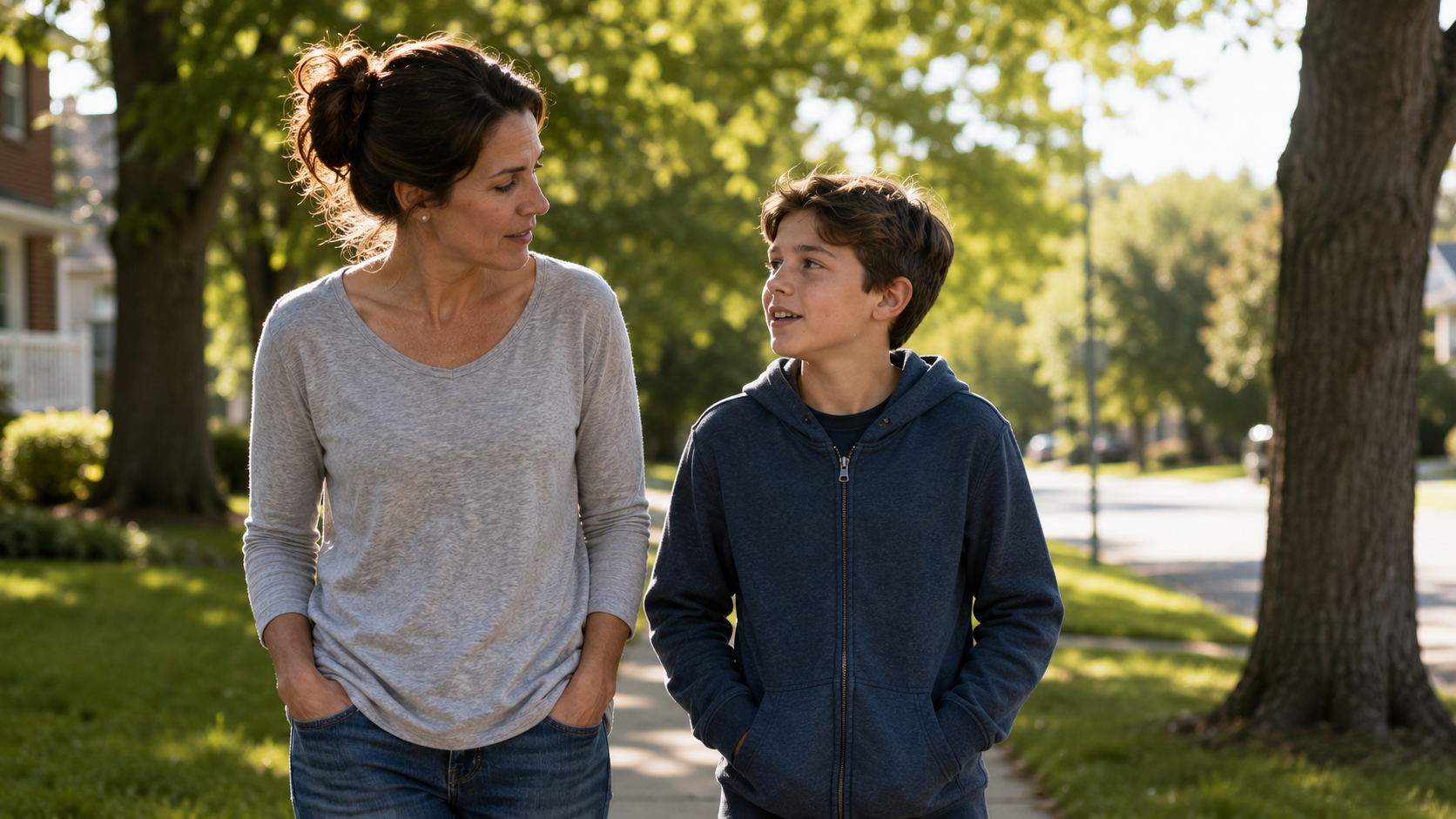
I used to take walks with my son...
Bring up issues wasn't about blaming him. I was giving him another perspective.
Connection doesn't replace guidance. It helps your guidance be heard.
What if my child gets angry every time it's time to stop gaming?
Anger isn't always about the game. Sometimes it's about an abrupt ending to something that matters to them. Instead of focusing only on stopping the anger, help your child prepare for the transition.
The more predictable and collaborative the transition becomes, the less they have to fight it. This is where the conversations ahead of time really matter.
How do I know if my child’s gaming has become a problem?
Gaming is not automatically unhealthy just because your child loves it or spends time with friends online. My son’s online friendships were real, meaningful, and lasting.
I would pay closer attention if gaming is consistently affecting sleep, replacing basic needs or other important parts of life, or causing intense outbursts every time your child has to transition away from it.
Sometimes this means your family needs clearer boundaries and more support with transitions.
Please note: I am not a licensed therapist, and this is not medical advice. If you are worried there may be something deeper happening, speak with your child’s doctor or a qualified mental health professional.
☀️Read More from My Summer Survival Series



Angela Thibault is the creator of Satori Kid Club and the author and illustrator of children’s stories that children’s stories that help children learn to process BIG feelings with confidence. She is a Relational Growth Specialist who guides families in practicing emotional awareness together through dual growth between the grown up and the child. A mother for twenty-eight years, Angela has spent the last fourteen years dedicated to early childhood emotional development and relationship-based learning.
Available Now!

Also Available in
Canada Online At:
(Availability May Vary)

and in the U.S. Online At:
(Availability May Vary)




Additional Posts You Might Like!