
Start your journey here
How to Prepare Your Family for Back-to-School BIG Feelings
All activities should be supervised by an adult.
Share

Successfully Shift from Summer to School by Preparing Everyone's Nervous System for Change with This Fun Technique.
Overview of article: Back-to-school season brings big feelings for everyone. Instead of focusing solely on the schedule, learn how to prepare your nervous systems together with Satori Kid Club. This technique uses The Parallel Journey™, our relational philosophy for understanding that children and grown-ups experience transitions differently and provides a practical, playful 'School Bus Tires' breathing technique. As a key 'Connect' step within The Satori Shift™ a 5-step way to process feelings. This technique helps families pause, regulate, and process big feelings proactively. Download the free printable tool from our member tool shed to bring this practice into your Growth Garden.
What You Will Learn in This Article:
- Why Transitions Are Hard for Kids: Gain a developmental science perspective on why back-to-school transitions can trigger resistance, helping you shift your expectations to meet your child’s developing brain where it actually is.
- Parental Self-Regulation: By practicing the Parallel Journey™, you’ll learn how to process your own feelings about the back-to-school transition and center your emotional state before you focus on your child's needs.
- Playful Co-Regulation Tools: Discover "School Bus Tires," a rhythmic breathing technique that uses silly sounds to naturally stimulate the vagus nerve and physically down-regulate the nervous system’s fight-or-flight response.
🌿 Free Companion Resource Included:
Free Growth Garden Tool Included: To help you put this into practice tonight, I’ve designed the School Bus Tires How to Sheet, an practical one page tool created to help you practice preparing your nervous system!
The Growth Garden Tool is a free resource when you join the Satori Kid Club Community—it’s completely free to join. Every week, straight to your inbox, I share one practical, bite-sized tool just like this to help you move past daily power struggles and get back to what really matters: building a stronger relationship with your child.
Download the free printable tool from our member tool shed to bring this practice into your Growth Garden.
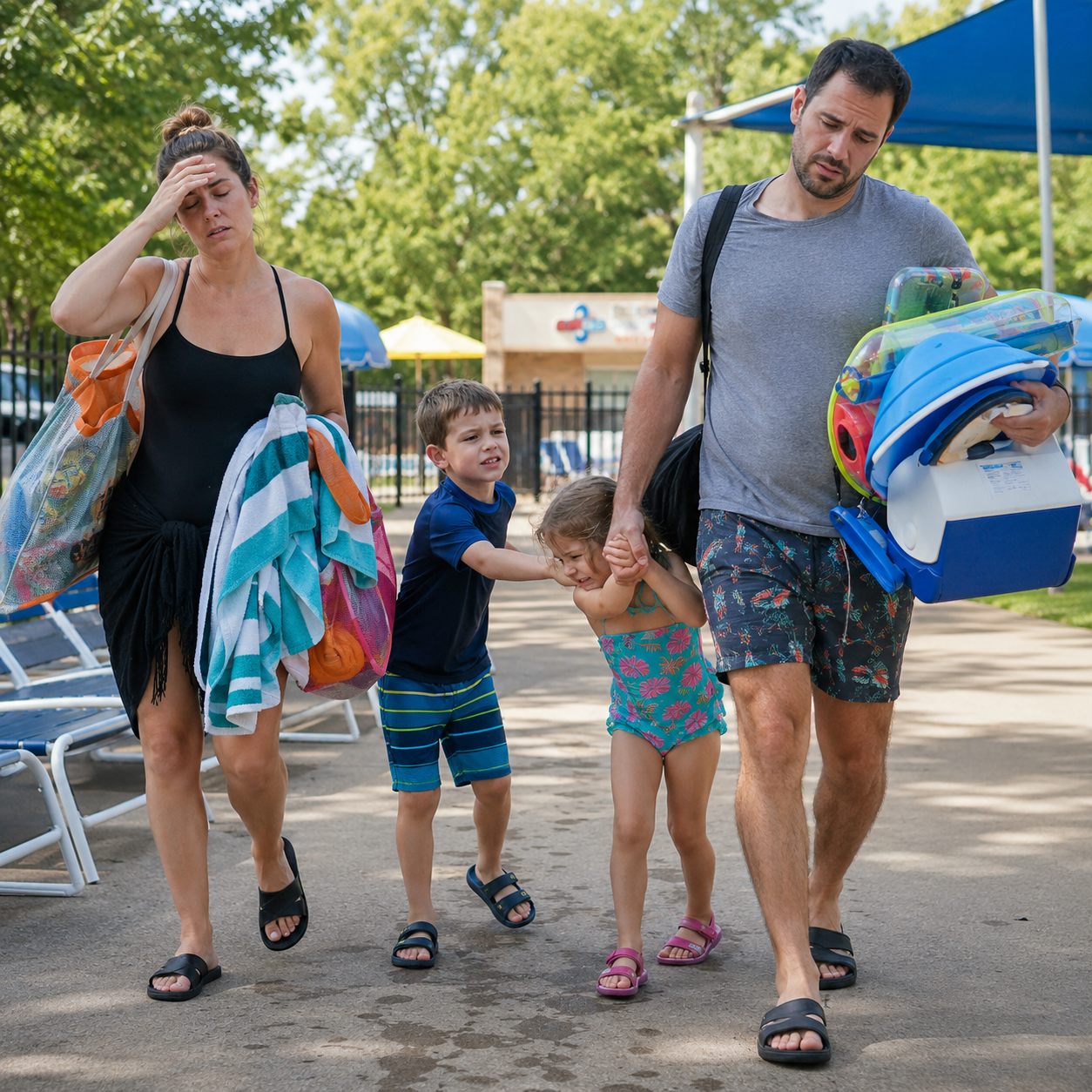
Going back to school can bring excitement, worry and resistance, sometimes all within the same child on the same day.
A child may talk happily about their new backpack and then refuse to get dressed.
They may complain of a stomachache, struggle to sleep or become upset by things that usually feel manageable. The American Academy of Pediatrics notes that children can become nervous about changes involving a new school, classroom or teacher, and anxiety may appear through physical symptoms such as feeling sick to the stomach. (HealthyChildren.org: Back-to-School Tips, Help Your Child Manage Anxiety)
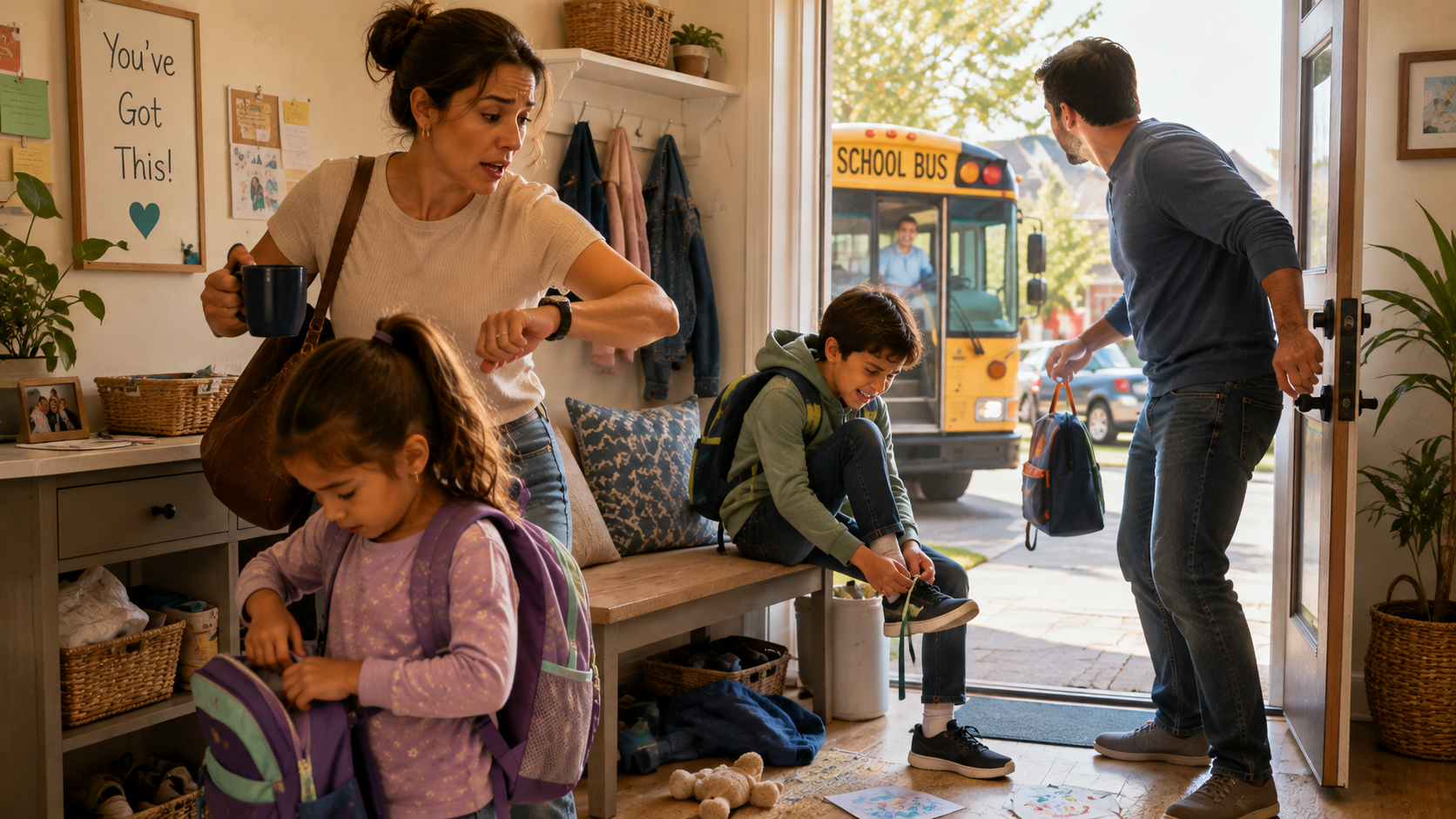
Parents, caregivers and educators may experience this shift differently, but grown-ups have feelings about it too. We may feel rushed, worried, hopeful or responsible for making the transition go smoothly.
What if preparing for school is not only about changing the child’s schedule?
What if it is also an opportunity for the child and grown-up to prepare their nervous systems for the shift together?
Are Back-to-School Nerves Shared? Understanding the Shift
The Parallel Journey™ teaches us that a child and grown-up can move through the same experience without experiencing it in the same way.
A child may be wondering:
- Will I know where to go?
- What if I miss my grown-up?
- What if the classroom is loud?
- What if I cannot explain what I need?
The grown-up may be thinking:
- What if we cannot get out the door on time?
- What if the child refuses to go?
- What if I make their anxiety worse?
- How am I supposed to help when I am worried too?
The goal is not to decide whose feelings are more reasonable. It is to recognize that both nervous systems are preparing for change.
Research-informed guidance on co-regulation emphasizes that children develop self-regulation with support from responsive grown-ups, predictable environments and opportunities to practice skills. (Administration for Children and Families: Co-Regulation From Birth Through Young Adulthood)
This means a grown-up does not have to stand outside the experience and direct the child toward calmness. We can and should practice alongside them.

In Rolls 'School Bus Tires': A Playful Way to Calm Big Feelings
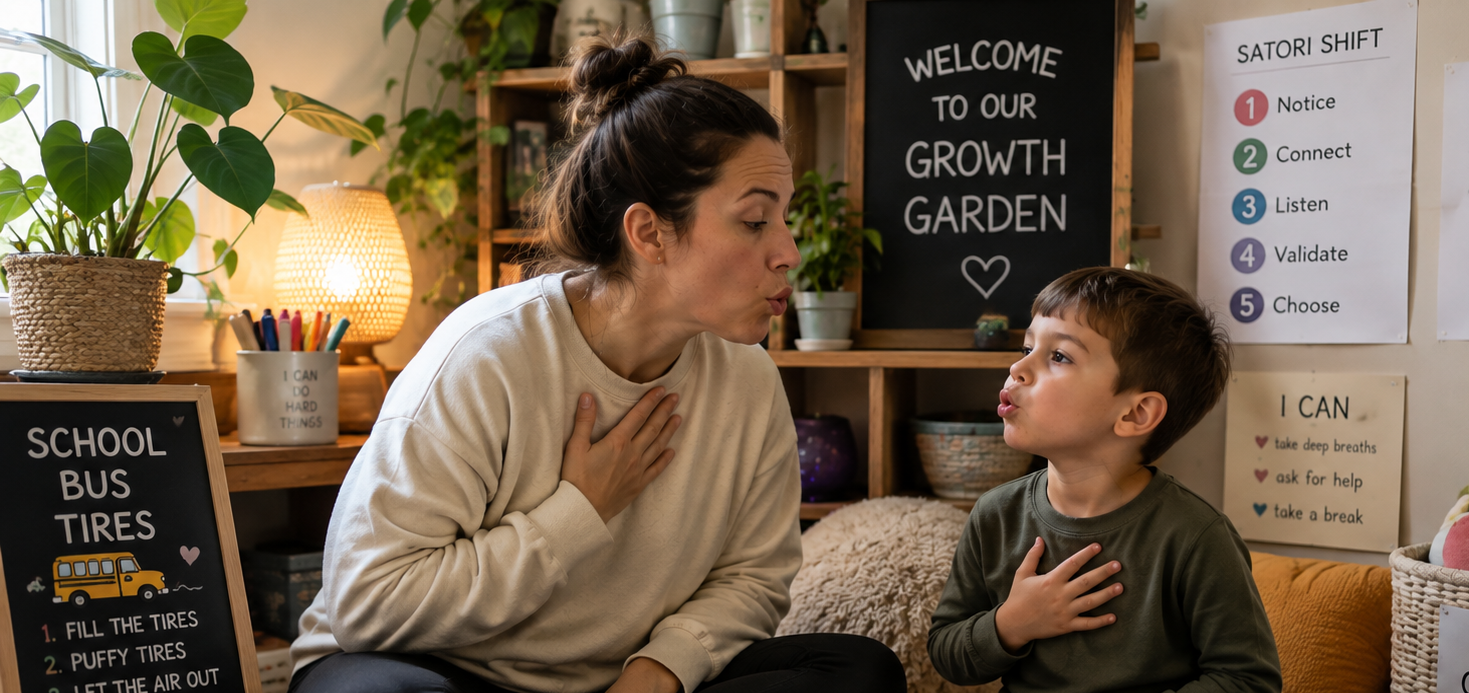
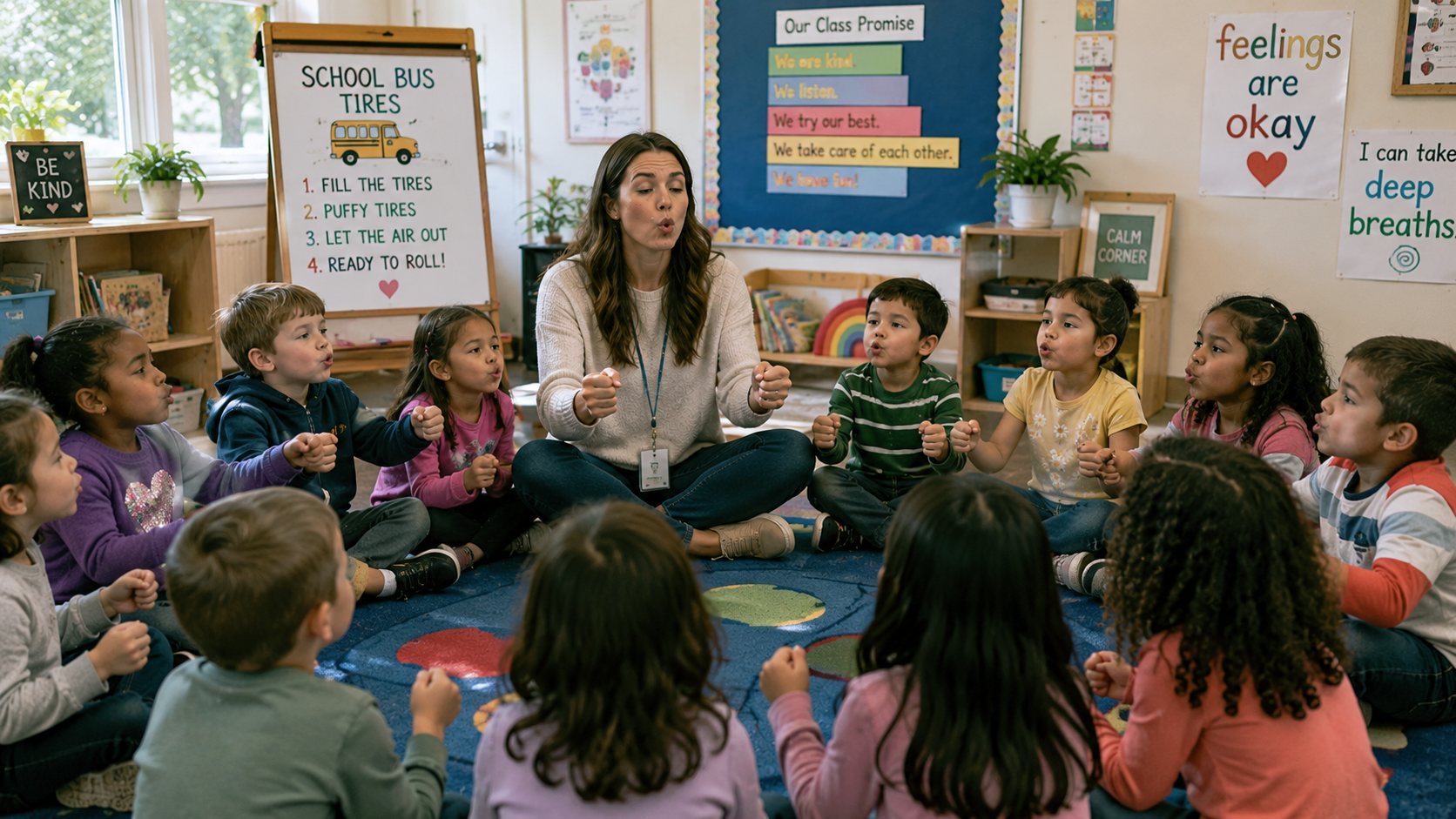
School Bus Tires is a playful breathing activity designed to help children and grown-ups prepare their bodies for the shift back to school.
Together, you pretend to fill the tires of a school bus with a BIG breath. You puff out your cheeks as though the tires are full, then slowly let the air escape through loose, floppy lips while making a silly tire or school-bus sound.
The purpose is not to make every worried feeling disappear.
The purpose is to pause, connect and notice what each person’s body may need next.
The technique does not make the decision for the child. It creates a small pause in which listening and choosing may become easier.
School Bus Tires Helps You Process Feelings
Here's an example of what using the technique School Bus Tires with the Satori Shift™ to help process BIG feelings might look like.
Step 1: Notice
You notice your child becomes tense and grumpy when they idea of going back to school comes up. After checking in with yourself too you realize you feel stressed about trying to balance a new schedule too.
Step 2: Connect
You suggest to your child that you practice the School Bus Tires technique in your Growth Garden. So, you practice the technique together, you breathe, puff your cheeks and make silly sounds together.
Step 3: Listen
After practicing, you can ask check in questions such as:
- What do you notice about your body now?
- Do you feel any different?
- Did any thoughts or specific worries come up about school you would like to chat about?
As the guide and grown up it important to check in with yourself. Notice how your body feels now. As yourself the same reflection type of questions.
Step 4: Validate
There are no required answers and no expectations that the child must feel calmer.
They may feel different, the same, sillier, more connected or ready to stop. Every response gives us information.
If they do give you a response it important that they know that these feelings are okay for them to have and they also don't need anyone else to tell them their feelings are valid. But it is good to have that extra support when they do share with you. This applies to you as he grown up as well. Your feelings are valid.
Step 5: Choose
As much as feelings are valid, we don't want to get stuck there. We must decide to move forward and that can take on many different forms.
Together, you and your child decide what comes next.
What can we do next once we are centered to help ourselves?
Download the free printable tool from our member tool shed to bring this practice into your Growth Garden.
Why Silly Sounds Work: The Science (and Fun) Behind the Breath
The tire sound encourages a slower, more noticeable exhale. A randomized controlled study of adults found that brief structured breathing practices, especially practices that emphasized exhalation, were associated with improved mood and reduced physiological arousal. School Bus Tires itself has not been clinically tested, and adult breathwork research should not be treated as proof of a specific result for every child. It does, however, support the use of simple breathing practices as one possible way to pause and notice the body. (Balban et al., Cell Reports Medicine, 2023)
The silly sounds add another important ingredient: play.
The American Academy of Pediatrics reports that play supports social-emotional development, self-regulation and the formation of safe, stable and nurturing relationships. Shared play can also create moments of joy, communication and connection between children and grown-ups. (The Power of Play, Pediatrics)
Puffy cheeks and ridiculous tire sounds can reduce the feeling that emotional practice is serious work a child must perform correctly.
You are not testing the child’s ability to breathe properly. You are being playful together while becoming more familiar with a shared practice.
Building Resilience: Growing a Satori Kid
Through repeated, pressure-free practice, a child has an opportunity to:
- Notice sensations in their body
- Experience connection before correction
- Explore a technique without being required to calm down
- Communicate whether a form of support feels helpful
- Discover that preparing for a transition can include play
- Participate in choosing what happens next
A Satori Kid is not a child who never becomes anxious, resists school or has BIG feelings.
A Satori Kid is learning that feelings can be noticed, expressed and explored with support.
Grown -Ups: Growing with a Satori Kid
This practice also gives the grown-up an opportunity to:
- Notice their own urgency around the school transition
- Connect before trying to persuade, reassure or correct
- Model participation instead of directing from outside
- Become curious about what the child’s body may be communicating
- Accept that one technique will not help every child every time
- Adapt the support without treating the child’s response as noncompliance
A Satori Grown-Up does not need to have a perfectly regulated nervous system before supporting a child.
Many of us as Grown Ups were never taught this as kids ourselves. It is okay that we are learning and practicing too.
Download the free printable tool from our member tool shed to bring this practice into your Growth Garden.
Grown -Ups: Growing with a Satori Kid
Your Growth Garden™ is a meant to be cozy little space where children and grown-ups learn to process BIG feelings.
It’s important to introduce School Bus Tires during a calm moment before school begins. Let the child look at the pictures, experiment with the tire sounds and decide whether the activity feels comfortable.
You might practice while talking about school, packing a backpack or reading a back-to-school story.
Practice is more than preparation. It is a proactive, preventive measure that builds familiarity before distress becomes a crisis.
Proactively practicing while everything is calm is important. Waiting until the child is already overwhelmed may make an unfamiliar technique feel like another adult's demand, ensuring resistance and push back from your child.
Anytime, Anywhere: Growing Your Practice Beyond the Garden
The Growth Garden is not limited to one permanent corner of a room. The practice can travel with you. You are building a skill to be used any time in life, not only when conditions are perfect for practicing. Just like practicing math , in the early stages you may use physical blocks and then later it’s a skill you can run in your mind. But it takes practice.
School Bus Tires might be used:
- Before leaving home
- In a parked car
- While waiting for the school bus
- Before entering the classroom
- During a classroom transition
- After school when the body is releasing the day
An educator might introduce it playfully to a group during a calm classroom moment. A caregiver might use it while preparing for a change in routine. A parent might practice it beside a child before getting into the car.
Grown-ups can participate too. This is something we do alongside a child, not something we instruct children to perform for us.
Practice Connecting through Story
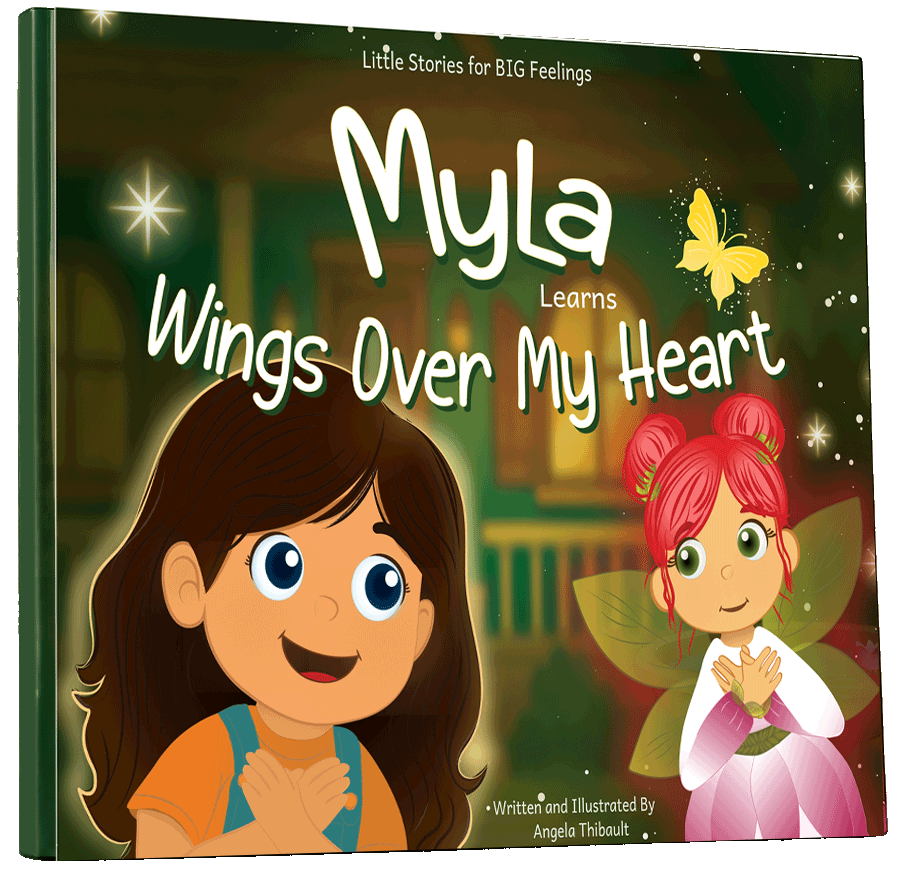
Myla is a six-year-old child who has BIG feelings about going to school.
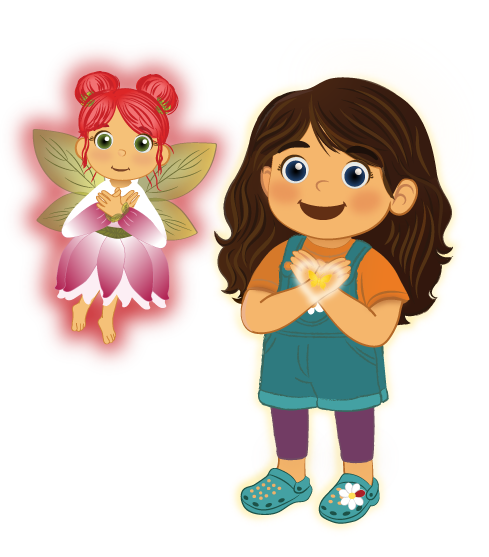
In Myla Learns Wings Over My Heart, Myla wakes with a stomachache and does not want to go. Aditha, the Energy Fairy, helps her notice that feelings can appear in the body for a reason.
Aditha does not tell Myla that her feelings are wrong. She offers a somatic practice called Wings Over My Heart based on Butterfly Taps and then gives Myla space to notice and helps her listen for the message underneath the feeling.
Just like the technique Wings Over My Heart, School Bus Tires is and fun somatic technique to try with Myla and her mom. It extends the same story-led approach by giving grown-ups and children another playful way to practice connection and body awareness during the shift back to school.
🌿Bring This Practice into Your Home:
Bring This Practice Home
Ready to keep practicing with Myla?
You'll find the School Bus Tires - Growth Garden Tool waiting in the Tool Shed, along with the Back-to-School Check-In Questions for both grown-up and child. Together, they make it easy to continue practicing connection through this week's Growth Garden experience.
The Tool Shed is available to all Satori Kid Club Members, and joining is completely free.
As a member, you'll also receive:
- 🌱 One new Growth Garden Tool each week to help you practice learning together.
- 🌱 Access to the growing Tool Shed library of printable resources.
- 🌱 Story-led tools inspired by Myla to help you explore and process BIG feelings together.
Come inside the Growth Garden and start building your Tool Shed—one practice at a time.
Download the free printable tool from our member tool shed to bring this practice into your Growth Garden.
☀️Read More from My Summer Survival Series


Angela Thibault is the creator of Satori Kid Club and the author and illustrator of children’s stories that children’s stories that help children learn to process BIG feelings with confidence. She is a Relational Growth Specialist who guides families in practicing emotional awareness together through dual growth between the grown up and the child. A mother for twenty-eight years, Angela has spent the last fourteen years dedicated to early childhood emotional development and relationship-based learning.
Available Now!
Also Available in
Canada Online At:
(Availability May Vary)

and in the U.S. Online At:
(Availability May Vary)




Additional Posts You Might Like!